
POLi casinos in Australia 2026: the button that stopped working, and what Aussies use now
 Available in AU

POLi and Australian casinos in 2026 — the short answer
No Australian casino accepts POLi in 2026. Australia Post shut the Australian arm of POLi Payments on 30 September 2023, after seventeen years of service, and nothing has replaced it under the same name. Any cashier still showing a POLi button to an Australian player is showing a dead control or a mislabelled bank transfer.
That is an awkward thing to read if you came here for a ranked list. It is also the only version of this page worth publishing, because the alternative is watching you attempt a deposit that cannot clear and then arguing with live chat about whose fault it was.
The confusion has staying power for a reason. POLi did not vanish. It still runs in New Zealand, under local ownership, with a working merchant network and a fresh set of bank partnerships. Its logo still sits in a handful of Australian-facing cashiers, sometimes with published limits and processing times next to it, as though the last three years never happened. Search results still carry pages promising “16 casinos accepting POLi” with tidy tables and no publication date visible. The service is genuinely alive; it is just not alive for anyone holding an Australian bank account.
What did survive is the thing you actually wanted from POLi. Log into your own internet banking, push money straight from your account to the casino, no card numbers, no wallet registration, funds on the table in under a minute. That experience now runs on PayID and Osko, sitting on Australia’s New Payments Platform, and it is faster and safer than the rail it replaced. Below you will find the operators an Australian bank account can reach in 2026, which instant bank rail each one actually runs, what each one charges you in wagering to take their “gift” of a welcome bonus, and the two cashiers still advertising POLi with a straight face.
Can I still use POLi at online casinos in Australia?
No. POLi Payments ceased Australian operations on 30 September 2023 and no casino can process a genuine Australian POLi deposit in 2026. Buttons and logos that remain in some cashiers are legacy artefacts. PayID and Osko now deliver the same instant bank-to-casino transfer, usually in under a minute.
What actually happened to POLi — and why it still runs in New Zealand
POLi Payments Pty Ltd started life in Melbourne as Centricom, and launched its payment product in 2006. The pitch was straightforward and, for its era, genuinely clever: give merchants a way to take money directly from a customer’s bank account without paying card-scheme fees. Merchants paid roughly 1% per transaction capped at three dollars, against card rates of 1% to 3% uncapped. Customers paid nothing. By May 2013 the system had moved more than a billion Australian dollars in cumulative value. Australia Post bought the company in December 2014 through its SecurePay Holdings subsidiary, and at its peak POLi worked with around twenty Australian institutions, the big four among them.
Then it stopped. Australia Post announced the closure in July 2023 and pulled the plug on 30 September that year.
The three forces that killed the Australian service
Banks went first. POLi worked by asking you to type your internet banking username and password into a POLi-hosted page, then using a proxied session to log in on your behalf and pre-fill a transfer. The industry term is screen scraping, and Australian banks had been warning customers off it since at least 2015. Their objection was not aesthetic. Handing over banking credentials to a third party sat badly against the terms of every electronic banking agreement in the country, and it meant the bank could not distinguish a legitimate POLi session from a fraudster with the same credentials. ASB in New Zealand went further and publicly accused POLi of standing up imitation login pages to harvest customer details. Support thinned bank by bank.
The New Payments Platform finished the job. Launched in 2018 and now connecting more than 120 banks, financial institutions and fintechs while clearing around six billion dollars a day, the NPP gave Australian consumers exactly what POLi offered, natively, from inside their own banking app, with no intermediary and no credentials handed anywhere. Osko settles in under ten seconds. Once your bank could do that on its own, paying a third party to impersonate you in your own internet banking session looked less like innovation and more like an artefact.
Third, the money stopped working. POLi’s irreversibility made it attractive to scammers, which drew more institutional scrutiny, which cost more compliance engineering, all against a shrinking merchant base. Australia Post concluded the Australian operation was no longer commercially viable and wound it down. Not a collapse, a decision. And because POLi never held balances, nothing was trapped: it was a thin layer between your banking session and a merchant’s account, so casino balances funded through POLi stayed exactly where they were. Only the deposit route disappeared.
Why using POLi may have voided your bank’s protection
Here is the part nobody mentions on the affiliate pages still recommending the thing. When Treasury published its discussion paper on screen scraping in August 2023, it noted the practice is inconsistent with best-practice cyber security advice and may pose risks to consumers through how the data is collected and handled. The ACCC’s submission was blunter, warning that encouraging consumers to agree to screen scraping may induce them to breach the terms and conditions of their contracts with their banks. The Law Council of Australia’s submission went furthest, stating that the practice exposes consumers to potential liability for fraud, because the consumer may be in breach of their financial institution’s contract terms by providing login details to a third party.
Read that chain backwards and it lands somewhere uncomfortable. Every POLi deposit you ever made was arguably a breach of your own banking agreement, and a breach of that agreement is precisely what a bank points at when it declines to reimburse an unauthorised transaction. The player chasing “instant POLi withdrawals” was hunting a method that had quietly traded away their fraud protection in exchange for dodging a surcharge. Australia’s Consumer Data Right has offered a sanctioned alternative since July 2020. In August 2024 the responsible minister gave Treasury twelve months to recommend a path to a full and formal ban on screen scraping. That deadline came and went without legislation, which is its own small comment on how quickly the market solved the problem on its own.

Same technology, opposite outcome across the Tasman
Now the genuinely odd bit. Cross the Tasman and the same product, from the same lineage, went the other way entirely.
When Australia Post exited, Merco Ltd, POLi’s New Zealand master distributor, acquired local ownership and kept the development team. The service continued without interruption for the 1.6 million New Zealanders who had used it recently. Then it got better. ASB, the bank that had been POLi’s harshest public critic, signed an API partnership in May 2025. Westpac New Zealand followed in July 2025. New Zealand open banking rules commenced on 1 December 2025, at which point banks began connecting POLi through approved APIs rather than tolerating credential entry. Eight New Zealand banks now support it, though four of them, Kiwibank, TSB, Bank Direct and The Co-operative Bank, had still not sanctioned APIs as of late 2026 and continue to require the old login flow.
So the technology that Australian banks starved out of existence was rescued in New Zealand by the exact regulatory reform Australia has spent years not quite passing. Same code, same objection, opposite result. If you have been finding “POLi casino” pages that read as current and accurate, there is a decent chance they are current and accurate for Auckland.
Will POLi come back to Australian casinos?
Very unlikely. The Australian entity was wound up, its bank integrations dismantled, and its function absorbed by PayID and Osko running natively inside banking apps. Rebuilding would mean rebuilding relationships with the same banks that withdrew support over screen scraping. Australia’s payment infrastructure moved on and has no gap left to fill.
What replaced POLi: PayID, Osko and the rest of the cashier
The replacement is not one product. It is a layered piece of national infrastructure with three names attached, and most cashiers use those names interchangeably, which does nobody any favours.
PayID and Osko are not the same thing
The New Payments Platform is the road. Built by NPP Australia, now part of Australian Payments Plus, live since 2018, it is the real-time interbank rail that runs around the clock. Osko is the branded overlay that BPAY built on top of it for real-time transfers, and it carries a free-text description field alongside the payment. PayID is the address book: it maps an email address, a mobile number or an ABN to a BSB and account number so you never have to type either.
They are not competing options. A PayID payment from an Osko-participating bank settles over Osko on the NPP. You can also send an Osko payment straight to a BSB and account number with no PayID involved, and it is the identical movement of money at the identical speed. When a cashier lists “PayID” and your bank statement later says “Osko”, nothing unusual has happened. There is no scenario in which one is faster than the other.
What matters practically is that this rail is app-native. POLi required a desktop browser and a full internet banking login, because the whole mechanism depended on driving a web banking session. Every “mobile casino that accepts POLi” query was chasing something that barely worked on a phone by design. The successor rail lives inside your banking app, authorises with the biometric or code you already use, and completes in seconds.
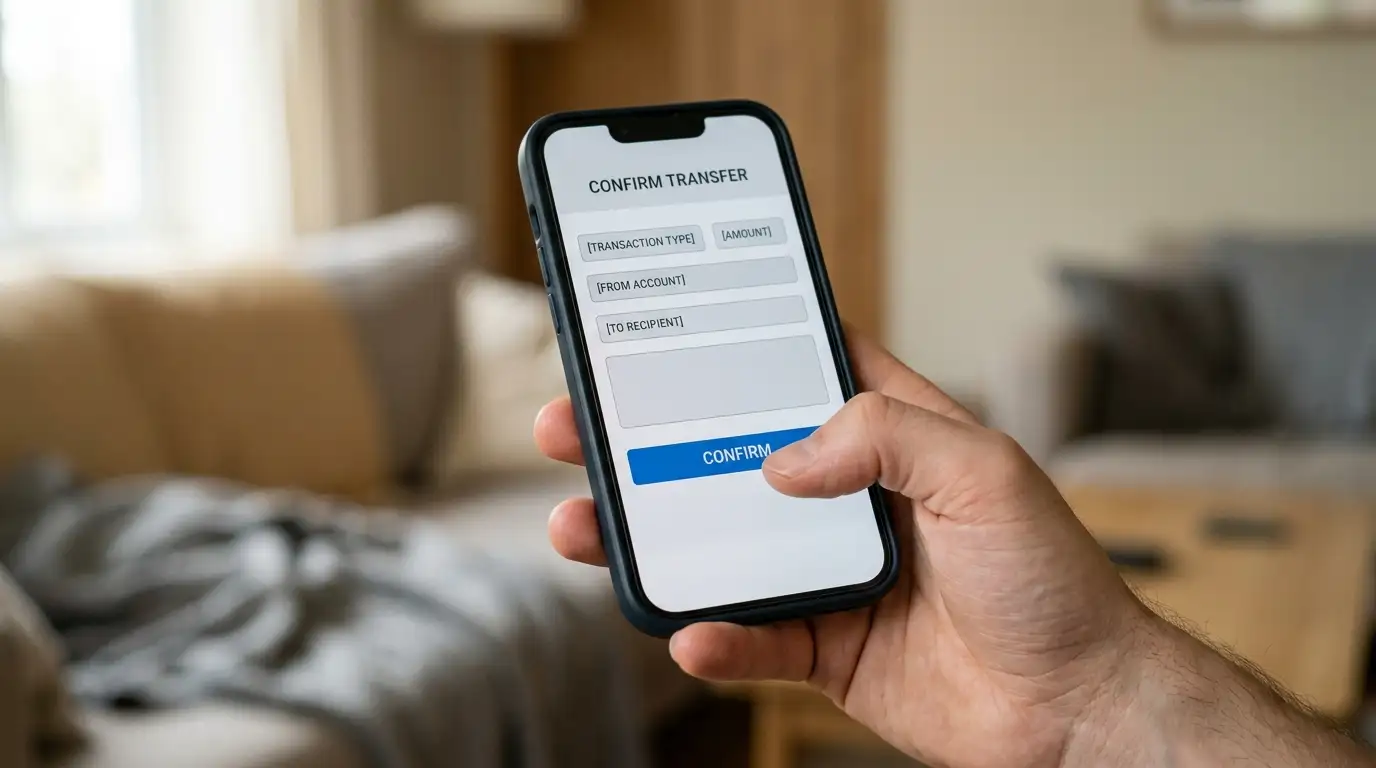
Making a PayID casino deposit, step by step
The flow is short enough that describing it takes longer than doing it. Open the cashier, choose PayID. The operator issues you a temporary PayID, usually an email address or phone number belonging to their payment processor, along with a reference string, and both typically expire in about thirty minutes. Switch to your banking app, choose to pay someone by PayID, paste the address, enter the amount, and put the reference in the description field. Osko verifies the receiving account name back to you before you confirm. Authorise, and the settlement leg completes in roughly four to eight seconds.
The reference is the part people skip, and it is the part that causes the support ticket. Money that settles without a matching reference has arrived at the processor but has nothing to attach it to, so your balance stays at zero while your bank insists the payment succeeded. Both statements are true. Live chat can match it manually if you hand them the transaction reference, but you will wait, and you will be annoyed.
Two habits remove almost all friction. Register your PayID with your bank once, against your everyday transaction account, and it never needs doing again. And check your daily limit before you get to the cashier rather than after a decline, because some limit changes take up to a day to clear a bank’s fraud layer.
Your bank’s daily limit is the new ceiling
This is the shift nobody flags, and it is the single most useful thing on this page.
POLi’s constraint belonged to the merchant. Each site set a per-transaction cap, you read it in the cashier, and that was the end of the negotiation. PayID’s real constraint belongs to you. Your bank sets a default daily outbound limit, and on the NPP that limit is what stops your deposit, not anything the casino decided.
The spread between banks is not small. Commonwealth Bank and Bankwest default to A$20,000 a day, liftable towards A$50,000 with NetCode. NAB and ubank default to A$25,000. Westpac, St.George and BankSA sit at A$20,000. ANZ is A$25,000. Bendigo and Adelaide, and BOQ, both default to A$10,000. MyState sits at A$5,000. And ING, conservatively, defaults to A$1,000 a day, adjustable in-app up towards A$20,000 with a slider most customers have never touched.
Run those numbers against a welcome offer and the picture sharpens. A four-tranche package asking A$1,600 on the first deposit is comfortable on a CommBank default and impossible on an ING default without changing a setting first. If your deposit keeps failing while the casino swears its cashier is fine, the casino is probably telling the truth. Other real causes exist: a bank risk-flagging the processor’s identifier, an unresolvable PayID address, the occasional NPP outage against roughly 99.9% uptime. But the limit is first on the list, and it lives in your banking app.

Neosurf, cards and crypto: when the bank rail is not the answer
Not every deposit should touch a bank account. Neosurf is a French prepaid voucher system sold across Australia at Coles, 7-Eleven, Australia Post outlets and newsagents. You buy a voucher, get a ten-digit code, and type it into the cashier. Minimums start at A$10, individual vouchers typically top out around A$250 and can be combined, and nothing gambling-shaped appears on your bank statement. The hard ceiling is the appeal for some players and the point for others: you cannot spend what you did not buy. CashToCode works similarly through a barcode paid in cash at a retail counter.
Cards still work sometimes. Visa and Mastercard remain in most offshore cashiers, but Australian banks decline transactions coded to offshore gambling merchants with increasing enthusiasm, and cards are almost always deposit-only at these sites. Worth knowing: the Interactive Gambling Amendment (Credit and Other Measures) Act 2023 banned credit cards, credit-related products and digital currency as payment for licensed wagering from 11 June 2024. That ban binds licensed Australian wagering operators. An offshore casino accepting your credit card or your Bitcoin is not demonstrating compliance with it. It is demonstrating that the rule does not reach them.
Crypto is the fastest route out and the furthest from any Australian protection. Bitcoin, Ethereum, Litecoin, Tether and a handful of others clear withdrawals in fifteen minutes to two hours at most operators here, with no fee and no meaningful ceiling. The speed is real. So is the distance.
| Method | Deposit speed | Minimum | Can it pay you out | Where it bites |
|---|---|---|---|---|
| PayID / Osko | 4–8 seconds to settle | A$10–A$30 | Yes, same-day to 6 hours at most sites | Your bank’s daily limit, from A$1,000 at ING to A$25,000 at NAB |
| POLi | Does not process Australian payments since 30 September 2023 | — | Never could, by design | The button may still be visible in some cashiers |
| Neosurf | Instant | A$10 | No, deposit only | A$250 per voucher, and you must register another route to withdraw |
| Visa / Mastercard | Instant | A$20 | No, deposit only at these sites | Australian banks decline offshore gambling codes often |
| Crypto | 10–30 minutes for network confirmation | A$20–A$25 equivalent | Yes, 15 minutes to 2 hours | Wrong network means permanently lost funds |
| Bank transfer | 1–3 days, up to 10 at some sites | A$20–A$50 | Yes, 2–7 business days | Slowest option in both directions |
Is PayID safe for casino deposits?
Safer than what it replaced. You initiate the payment yourself from inside your own banking app, so no third party ever sees your login credentials, and Osko confirms the receiving account name before you authorise. The transfer is still irreversible once sent, and depositing at an offshore casino carries no Australian consumer protection regardless of the rail.
Why did my PayID casino deposit get declined?
Most often your bank’s daily outbound limit was already reached, which is fixable in your banking app. Other causes: the bank risk-flagged the payment processor, the casino’s temporary PayID had expired or was mistyped, or an NPP outage. If money left your account but no balance appeared, the reference did not match and live chat can trace it.
Why no casino will ever pay you out through POLi
A large share of the searches that land on pages like this one ask for instant POLi withdrawals. There is a whole vocabulary around it, as though it were a product category with brands competing inside it. It never existed. Not in Australia, not in New Zealand, not at any operator, at any point in POLi’s seventeen years.
The one-way instruction
The reason is architectural rather than commercial, which is why no operator could have chosen differently. POLi issued a bank-level debit instruction: it authorised a single pull of a specified amount from your account to the merchant’s. That instruction type only travels one direction. Sending money back to you would require a credit transaction pushed through a channel built exclusively for debits, and banks do not permit that — not as a policy preference, but because the channel has no mechanism for it.
So POLi was deposit-only from birth. Australians who funded casino accounts through it were always receiving winnings by something else: bank transfer, an e-wallet, later crypto. When the deposit route closed in September 2023, their withdrawal arrangements were entirely unaffected, because those arrangements had never involved POLi in the first place. Every “casino with POLi withdrawal” listing you find is either describing a site that lets you deposit by POLi and withdraw by something unrelated, or is simply padding a page with a phrase people search for.

What actually pays out, and how fast
Three routes carry money out of these cashiers, and the gap between them is wide enough to matter more than any welcome bonus.
Crypto is fastest. Fifteen minutes to two hours at most operators, usually no fee, minimum cashouts around A$20 to A$30. Bitcoin over the Lightning network at Joe Fortune clears in minutes once approval is granted, though approval itself runs around a day.
E-wallets sit in the middle. MiFinity, eZeeWallet and Skrill typically pay within two to six hours of approval, sometimes with a fee up to 2%, on minimums of A$10 to A$20. Where an operator supports outbound PayID, it behaves similarly: Bizzo pays same-day, Ricky Casino reports two to four hours, Neospin three to six.
Bank transfer is slowest and most predictable. Two to seven business days at most sites, with approval taking one to three days and transit adding one to five more. Joe Fortune publishes five to ten business days. Fees run from nothing to about A$2.50, minimums from A$20 to A$50.
Two constraints catch people out. First, weekly and daily caps: across this set they run from A$100 to A$10,000 depending on operator and verification status, and WinSpirit’s A$2,000 per-transaction ceiling means a five-figure balance leaves in instalments. Royal Reels caps daily withdrawals at A$9,000. Second, method consistency. Several operators require winnings to return by the deposit method where possible, which is impossible for Neosurf and was impossible for POLi. Register a withdrawal route before you deposit, not after you win. The moment you actually want your money is the worst possible moment to discover you need to upload a utility bill.
Can you withdraw casino winnings to POLi?
Never, at any casino, in any market. POLi issued one-way bank debit instructions, so it had no technical channel to send money back to a player. Withdrawals from these operators run through bank transfer, e-wallets like MiFinity or Skrill, outbound PayID at some sites, or cryptocurrency. Register one before depositing.
The casinos an Australian bank account can actually reach in 2026
Ten operators follow. Every one of them holds an offshore licence, most commonly from Curaçao, and not one holds an Australian licence — because no Australian online casino licence exists to hold. Two of them still publish POLi in their own cashier documentation, which is why they lead the list rather than trail it.
Order here follows relevance to the POLi question, not bonus size. The ghost-listing cases come first because they are the ones that will waste your time, then the cleanest working bank rails, then the specialists, then the operator where the whole POLi-shaped experience is simply unavailable.
| Operator | Licence | Instant bank rail | Minimum deposit | Payout speed | Distinguishing feature |
|---|---|---|---|---|---|
| Bizzo Casino | Curaçao | PayID, A$10–A$8,000 | A$10 | Same-day on PayID, ~20 min crypto | Still publishes POLi at A$10–A$2,000 beside a working PayID rail |
| Fair Go Casino | Curaçao Gaming Authority | PayID, A$10–A$2,000 | A$10 via Neosurf, A$20 card | 2–10 business days bank, 5–30 min crypto | Publishes POLi at A$20–A$1,000 with claimed bonus eligibility |
| SkyCrown | Curaçao (Hollycorn N.V.) | PayID | A$30 | Instant deposits, no fees either direction | 10,400+ titles and Apple Pay in the cashier |
| Neospin | Curaçao | PayID | A$30 | 3–6 hours on PayID | No POLi entry at all; A$10,000 headline pool |
| RocketPlay | Curaçao GCB, OGL/2023/174/0082 | PayID | A$10 | Under an hour on crypto | Citable licence number and segregated player funds |
| Ricky Casino | Offshore | PayID | A$30 | 2–4 hours on PayID | PayID, Skrill, crypto and cards in one cashier |
| WinSpirit | Curaçao eGaming | Inpay bank transfer | A$10 | 3–5 business days bank | A$2,000 per-transaction withdrawal ceiling |
| Royal Reels | Disputed; ACMA formal warning July 2023 | PayID | A$30, or A$10 no-deposit trial | Fast crypto, A$9,000 daily cap | The only operator here with a regulator warning on record |
| Stake | Curaçao GCB, 8048/JAZ (Medium Rare N.V.) | None; crypto-first | Crypto only in practice | Minutes on crypto | Rakeback instead of a matched bonus, so no wagering to clear |
| Joe Fortune | Curaçao | None | A$20 on cards | Minutes on Lightning, 5–10 days bank | Aristocrat and IGT pokies; no instant bank rail whatsoever |
Bizzo Casino
Bizzo runs AUD as its primary account currency, which removes the quiet conversion tax you pay at operators defaulting to euros, and carries somewhere between 5,500 and 9,000 games depending on when anyone last counted. The studio list is genuinely deep: Pragmatic Play, Play’n GO, Evolution Gaming with its full live range, Hacksaw Gaming, Yggdrasil, Big Time Gaming, Spribe, Relax Gaming, NetEnt and Microgaming. Its published cashier table lists PayID from A$10 up to A$8,000 with same-day withdrawals, crypto from A$20 clearing in about twenty minutes with no upper limit, bank transfer from A$20 to A$10,000 over one to three days, and Neosurf from A$10 to A$500.
It also lists POLi. A$10 minimum, A$2,000 maximum, processing time given as instant.
That entry has been describing a rail that cannot move an Australian dollar for three years. Nobody at Bizzo appears to have removed the row, and the specificity is what makes it convincing — a stale logo is easy to dismiss, but a logo with a minimum, a maximum and a processing time reads like documentation. It is not. Ignore that row and the site is one of the better AU-facing cashiers here.
The welcome structure spreads A$7,250 and 200 free spins across four deposits: 100% up to A$1,600 with 70 spins, then 75% up to A$2,000 with 50, then the same again, then 50% up to A$1,650 with 30. Every tranche accepts A$10 and carries 40x wagering counted separately, which is better than it sounds — separate tranches mean a failed clearance on deposit two does not poison deposit three. There is also a randomised daily bonus that changes every twenty-four hours, worth checking and worth not planning around.
Why does a casino still show the POLi logo if the payment does not work?
Cashier integrations are rarely audited once built. When a payment provider exits a market, the operator must actively remove the option, and offshore sites serving multiple countries often leave regional rails in place because removing them costs developer time and generates no revenue. Selecting it either errors out or silently redirects to bank transfer.
Fair Go Casino
Fair Go has been serving Australians since 2017 under a Curaçao Gaming Authority licence, which makes it the longest-running dedicated AU brand on this list. Its catalogue comes exclusively from RealTime Gaming — Cash Bandits, Bubble Bubble, the whole RTG library and nothing else. Single-provider is a real trade-off, honestly stated: the games are familiar and consistent, the volatility profiles are known quantities, and once you have worked through them there is nothing new arriving from another studio next month.
Its own deposit documentation is where this gets interesting. Neosurf sits at A$10 to A$250 per voucher with vouchers combinable, CashToCode at A$25 to A$1,000, PayID at A$10 to A$2,000 instant, cards at A$20 to A$2,000, bank transfer from A$50 over two to ten business days, and crypto from roughly A$25 equivalent up to A$10,000, clearing in five to thirty minutes. Then POLi: A$20 minimum, A$1,000 maximum, instant processing, no fees, and an explicit statement that POLi deposits are eligible for the welcome bonus.
The page goes further than a stale table row. It describes the redirect to your bank’s secure portal in the present tense, explains that no financial details are stored, and notes that Australians particularly trust the method for its directness. All of which was true in 2022. None of which describes anything you can do today. If you have wondered why the internet is still full of confident POLi advice, this is the mechanism: operators keep publishing it, affiliates keep copying it, and nobody checks.
The bonus arithmetic is comparatively gentle. Five deposits at 100% up to A$200 each builds to A$1,000 total plus 100 free spins, with 30x wagering on deposit plus bonus combined and no maximum cashout on deposit-bonus winnings — a rarer concession than the headline numbers elsewhere. Separately there is an A$15 no-deposit chip, but read the terms before you get excited: 60x wagering and an A$180 cashout ceiling. Sixty times fifteen is A$900 of required turnover to convert a “free” chip into at most A$180. The chip costs nothing, which is the only sense in which it is free.

SkyCrown
Operating since 2022 under Hollycorn N.V. with a Curaçao licence, SkyCrown carries the largest catalogue here — counted at 10,400 titles in recent reviews, with Pragmatic Play, IGTech, Booongo, BGaming and Evolution supplying the bulk. It is also the closest thing on this list to a mainstream retail checkout: Visa, Mastercard, Maestro, Neosurf, MiFinity, PayID, Apple Pay and eZeeWallet, plus crypto, with no fees on deposits or withdrawals in either direction. Minimum deposit and minimum withdrawal both sit at A$30. There is no POLi listing anywhere in the cashier, which after the previous two entries counts as housekeeping worth noting.
The welcome package rewards reading. First deposit is 120% up to A$1,200 with 125 free spins on Wolf Treasure, and the terms attached are where the headline shrinks: 40x wagering applied to deposit plus bonus plus free-spin winnings combined, maximum bet capped at A$7.50 while any wagering is outstanding, free-spin winnings capped at A$300, and a per-stage cashout ceiling of A$5,000. Each stage runs on a fourteen-day window.
That combination has a specific consequence. Clear the first stage, hit something substantial, and A$5,000 is what reaches the withdrawal queue regardless of what the balance says. The rest waits for the next stage’s wagering. A fortnight is also not long to turn over 40x on A$1,200 plus A$300 of spin winnings while capped at A$7.50 a spin — that is a maths problem with a defined answer, and the answer is a lot of sessions. SkyCrown suits players who want catalogue depth and a cashier that behaves like a normal shop, and who treat the bonus as incidental rather than as the reason to sign up.
Neospin
Neospin is the clearest picture on this list of what an Australian cashier built after POLi’s death looks like: PayID-first, AUD-denominated, and carrying no legacy POLi entry whatsoever. Nothing to ignore, nothing to misread. PayID payouts land in three to six hours. The lobby leans on the studios most Australian players already recognise, Pragmatic Play with Gates of Olympus and Sweet Bonanza, Hacksaw Gaming with Wanted Dead or a Wild, Push Gaming with Razor Shark.
Its welcome pool is the largest figure on file for an AU-facing operator, A$10,000 plus 100 free spins, and it is worth doing the division out loud. That total is distributed across multiple deposits, not awarded at once. The first deposit gets 100% up to A$1,500 with the 100 spins, at a A$30 minimum, carrying 40x wagering. A A$1,500 bonus at 40x means A$60,000 of qualifying play before any of it converts to withdrawable funds. Reaching the A$10,000 ceiling means repeating that exercise several times over.
There is no no-deposit offer, so there is no way to see the real-money environment without committing A$30 first. Neospin fits a player with a sustained bankroll who understands they are buying a long programme, not a windfall. Anyone looking for a cheap look around should start elsewhere on this list.
RocketPlay
RocketPlay is the only operator here whose licence you can actually look up: Curaçao Gaming Control Board, number OGL/2023/174/0082. That sounds like a small thing next to a A$10,000 headline elsewhere, and it is not. It also holds player balances separately from operational funds, runs 128-bit SSL on its payment pages, and offers deposit limits, time-outs, loss caps and self-exclusion directly in account settings rather than buried behind a support ticket.
The catalogue runs past 3,600 games from more than 70 providers, including 85-plus live dealer tables and an unusually large crash and mines section. Rocket-X, its in-house crash title, exists nowhere else, which is a genuine differentiator in a market where every lobby is assembled from the same studio contracts. Wagering sits at 40x, the AU minimum deposit is reported at A$10 in Australian-facing reviews, and crypto withdrawals clear inside an hour. No downloadable app — the site runs in the browser, which is standard here and occasionally frustrating on older phones.
For a reader whose main worry after reading the legality section below is “who is actually accountable,” RocketPlay gives the most checkable answer available offshore. That is not the same as Australian consumer protection. It is what substitutes for it.
Ricky Casino
Ricky’s argument is optionality. PayID for bank-rail speed, Skrill for e-wallet routing, crypto for when your bank has decided it dislikes you, and cards for the days they work — the broadest payment mix on this list, backed by 4,000-plus pokies from Pragmatic Play, Hacksaw Gaming and Push Gaming among others. PayID withdrawals report at two to four hours, which is at the quick end of the set.
Then the bonus terms, which are the worst here. A$7,500 and 550 free spins sounds substantial until you find the structure: ten separate deposits, each needing A$30 minimum, at 50x wagering. The first deposit is a 100% match up to A$500 with 100 spins. Five hundred at fifty times is A$25,000 of turnover to convert a A$500 bonus. Multiply that across ten stages and the headline stops being a number and starts being a lifestyle. There is no no-deposit option either, so the entry price is A$30 regardless.
None of which makes the operator a poor choice. It makes the bonus a poor reason to choose it. If your actual problem is that your bank keeps declining offshore transactions and you want four ways around that in one cashier, Ricky solves your problem. Take the first-deposit match if you want it and let the other nine stages go.
WinSpirit
Live since 2022 under a Curaçao eGaming licence, WinSpirit puts a casino and a sportsbook on the same wallet, with AFL, NRL and cricket markets alongside a catalogue counted anywhere from 2,500 titles across 64 providers to 7,400 across 70, depending on which review you read and when. Its entry price is the lowest here: A$10 minimum deposit, across Visa, Mastercard, Neosurf, CashToCode, MiFinity, Inpay bank transfer, and six cryptocurrencies including Bitcoin, Ethereum, Litecoin, Dogecoin, Solana and Tether.
The exit is where you should look harder, because the operator does not publish payout timings on its own site — a gap worth naming rather than filling with a guess. What it does publish is the ceiling: A$50 minimum withdrawal and a A$2,000 cap per transaction. A five-figure balance therefore leaves in instalments, request by request, with each one subject to its own review. Bank transfer payouts run three to five business days after the casino-side pending period clears.
Wagering sits at 40x on promotions, with the AU-facing welcome package reported around A$2,000 plus 100 free spins. WinSpirit suits a low-stakes player who wants sports and pokies in one account and does not expect to be moving large sums out quickly. If a big win is the scenario you are planning for, the per-transaction ceiling deserves more weight than the A$10 entry.
Royal Reels
This one requires the warning before the description. Royal Reels is operated by Digibrite S.R.L., established 2023, serving Australia and New Zealand with AUD and NZD accounts across a casino and sportsbook. On 8 May 2023 the ACMA opened an investigation into whether the Reef Reels and Royal Reels services were providing prohibited interactive gambling services in contravention of the Interactive Gambling Act. In July 2023 it published a formal warning to Digibrite S.R.L. under section 64A of that Act. Reporting on the operator’s current licensing conflicts — some reviews cite a Curaçao licence, at least one independent assessment records no recognised gambling licence at all — and that ambiguity is itself worth weighing.
Casino Guru assigns the site a high safety index, driven largely by catalogue scale rather than regulatory standing: 2,000 to 3,000-plus pokies from more than 30 providers including Pragmatic Play, Evolution, Yggdrasil and Hacksaw Gaming, a ten-tier VIP structure, PayID deposits and quick crypto payouts across BTC, ETH, USDT and USDC. Independent reviewers separately document withdrawal delays, account closures after wins, mirror domains, and a terms clause permitting confiscation of winnings for “betting technique” during bonus play — a phrase elastic enough to mean whatever the operator needs it to mean.
The offer is the cheapest look-around here: A$10 with no deposit required, then 100% up to A$500 on a A$30 first deposit at 30x, against a A$9,000 daily withdrawal cap. So the entry is genuinely low-risk and the exit is where every documented problem lives. That is a useful shape to recognise, and not only at this operator: a free trial costs you nothing precisely because the operator’s margin was never in the trial.
What is the smallest PayID casino deposit an Australian player can make?
A$10 at the lowest-entry operators on this list, including Bizzo, RocketPlay and WinSpirit, rising to A$30 at SkyCrown, Neospin and Ricky Casino. Bonus eligibility often requires more than the technical minimum, so a A$10 deposit may fund play without qualifying for a welcome offer. Check both figures.
Stake
Stake is the outlier, and for one type of reader the right answer. Operated by Medium Rare N.V. under Curaçao Gaming Control Board licence 8048/JAZ and running since 2017, it carries more than 3,000 games including Pragmatic Play, Hacksaw Gaming and Evolution alongside in-house originals, with the widest cryptocurrency support on this list. Its terms exclude a long roster of markets — the United States, United Kingdom, Brazil, Mexico, Germany and Spain among them — and it is unreachable from Japan.
What sets it apart is the absence of the thing every other operator here leads with. Stake runs no conventional matched welcome bonus for Australian players. Value comes back as VIP rakeback on turnover instead. There is no A$10,000 headline, and consequently no 40x multiple standing between you and your own money. For a player who has read the wagering arithmetic three times on this page and drawn the obvious conclusion, that is not a missing feature. It is the feature.
The trade is that this is a crypto-first cashier. If you want to fund an account from your banking app in four seconds, Stake is the wrong door. If your bank has spent six months declining everything you send offshore and you would rather route around the banking system entirely, it is the most established option here, with withdrawals in minutes and no practical ceiling on the crypto rail.
Joe Fortune
Joe Fortune closes the list because it answers the original question by refusing it. There is no POLi in the cashier. There is also no PayID — the operator says so itself, noting that the NPP rails offshore casinos would need are difficult for them to access. So the instant bank transfer you came looking for does not exist here at any price, under any name.
What does exist is the most locally familiar game library on this page. Aristocrat and IGT sit alongside Pragmatic Play and Quickspin, meaning the pokies are the same studios you have played in a pub in Footscray or a club in Parramatta. Nobody else here matches that, and for a certain player it outweighs every cashier consideration. The published cashier runs Visa and Mastercard from A$20, instant, capped around A$1,500 per deposit and deposit-only; Bitcoin including Lightning, clearing in minutes once approval lands after roughly a day; BCH, BSV, LTC, ETH and USDT within an hour of approval; bank or wire transfer at five to ten business days each way; and cheque by courier at four to seven business days, which in 2026 is less a payment method than a museum exhibit.
Practically, that means crypto or patience. First withdrawal triggers identity verification, so have your ID and proof of address ready rather than discovering the requirement at the worst moment. Joe Fortune is for the player who came for Aristocrat titles and will adapt their banking to get them. Anyone who came for the POLi experience specifically should read one of the nine entries above instead.
How this list was put together
Ten operators is not a magic number. It is how many sites cleared a specific test: an Australian bank account can reach them, they publish enough cashier detail to verify rather than assume, and they have something distinct to say about the question of instant bank deposits after POLi.
What got an operator onto the list
Three filters, applied in order. First, reachability — AUD accounts, Australian-facing terms, and a cashier that presents Australian payment rails rather than a translated European skin. Second, verifiable cashier detail: published minimums, published limits, published or reliably reported payout windows. Where an operator does not publish something, that gap is stated here rather than filled with a plausible-looking figure. WinSpirit’s missing payout timings and the disagreement over Royal Reels’ licence status are both in the text above for exactly that reason.
Third, relevance to POLi specifically. That is why Bizzo and Fair Go lead: they are the two operators whose own documentation still advertises the dead rail, which makes them the most likely source of a wasted afternoon. It is also why Joe Fortune is included despite having no instant bank rail at all. An honest map has to show where the road ends.
Bonus size was deliberately not a ranking factor, and the arithmetic in each entry explains why. A headline figure divided by its wagering multiple, then capped by its maximum cashout, produces a much smaller and much more honest number. A A$500 match at 50x asks more of you than a A$1,600 match at 40x. Nobody advertises that ratio, so it is worth calculating before it calculates you.
Why a brand-new POLi casino is a contradiction
A steady stream of searches asks for new POLi casinos, new POLi pokies, the latest sites accepting the method. The category cannot be populated. Any site launched after September 2023 was built in a market where the Australian POLi integration no longer existed to build against — there was no merchant account to open, no gateway to connect, no bank support to negotiate.
So a genuinely new operator advertising POLi to Australians has done one of two things. It copied a competitor’s payment list without checking it, which tells you something about its operational care. Or it is describing a New Zealand integration on a page shown to Australian visitors, which tells you something about its geographic targeting. Neither is a reason to deposit. New operators are worth a look for other reasons — fresher lobbies, sharper welcome terms, less legacy cruft in the cashier. Just not for that one.

The law: what the Interactive Gambling Act does and does not prohibit
Every operator named above is offshore, and that is not an accident of this list’s construction. It is the structure of the entire market.
The Interactive Gambling Act 2001 makes it an offence to provide online casino games, online pokies and in-play sports betting to people in Australia. Banned services also must not be advertised here, and must not promote or offer credit for online betting. There is no online casino licence available anywhere in the country — not federally, not in any state or territory. Roughly 150 operators hold state or territory wagering licences, concentrated in the Northern Territory through its Racing and Wagering Commission with terms running up to twenty years, and every one of them is barred from offering you a pokie. Table games, roulette, blackjack, baccarat, live dealer studios, crash titles: all of it sits on the prohibited side of the line, which is why the question is never “which licensed Australian casino takes PayID” but always “which offshore operator does.”
The Act targets operators, not players
This distinction does most of the work in practice. The IGA criminalises the provision of a prohibited service, not the act of using one. An individual depositing at an offshore casino is not prosecuted under it, and there is no Australian precedent suggesting otherwise.
Enforcement runs at the supply side instead, and it is not idle. Since the ACMA’s first blocking request in November 2019, 1,788 illegal gambling and affiliate websites have been blocked, with recent rounds naming Zizobet, KingAUD, Lucky Vibe, Daily Spins, Gambiva, Casea, Crown96, and Lightning-bet.com for imitating a licensed service. More than 230 services have withdrawn from the Australian market since the 2017 amendment gave the regulator real tools, including the ability to refer company directors to the Australian Border Force.
Which produces the market you are actually navigating. You are not breaking a law by depositing. You are also not standing anywhere a law protects you.
The protection you give up
Australian-licensed wagering operators carry the ten measures of the National Consumer Protection Framework: identity verification, deposit-limit tools, activity statements, restrictions on inducements, account-closure rights, voluntary pre-commitment, and BetStop, the national self-exclusion register at betstop.gov.au. Sign up to BetStop and you are excluded from every Australian licensed online and phone wagering service in a single step.
None of that reaches the operators above. Not one of them is bound by BetStop, so self-exclusion there does nothing here. No Australian regulator will help you recover funds from an operator that declines a withdrawal or invokes a clause about “betting technique.” No Australian consumer-protection framework applies to the transaction. The credit-card and digital-currency ban that has bound licensed wagering since 11 June 2024 does not bind them either — which is exactly why they can still take your card and your Bitcoin. That acceptance is a measure of regulatory distance, not of compliance.
If you want the protections, the trade is real and it is narrow: licensed Australian wagering covers racing and sport, and it does not cover a single pokie. There is no version of this where you get both.
What changes on 1 January 2027
The Interactive Gambling Amendment (Gambling Reform) Bill 2026 passed Parliament on 19 August 2026, with most provisions commencing 1 January 2027. It restricts gambling advertising across television, radio, online and sports venues, establishes a global opt-out register for gambling advertising, and restricts direct marketing of inducements to new account holders during their first fourteen days, to anyone who deregistered from BetStop within the previous three months, and to any customer identified as at risk of gambling-related harm. It bans commissions to staff or affiliates based on customer activity, strengthens BetStop’s operation, addresses harmful online lottery products, and boosts enforcement including powers to take down advertisements and illegal services.
Most of that tightens the licensed side further, which widens rather than narrows the gap this page describes. The takedown powers are the part that touches offshore operators, and the practical effect will be more names on the blocked list. Worth knowing if a site you use goes dark without notice: that is usually what happened.
Am I breaking the law by depositing at one of these casinos?
No. The Interactive Gambling Act 2001 makes it an offence to provide prohibited online casino services to Australians, not to use them, and individual players are not prosecuted under it. The consequence is different: you forfeit every Australian consumer protection, including BetStop self-exclusion and any regulatory route to recover withheld funds.
Staying in control when the deposit clears in four seconds
There is an underrated detail in everything above, and it has nothing to do with which operator has the biggest bonus.
POLi was slow. Not the settlement — that part was fast — but the flow around it. You had to be at a desktop, open your bank’s website, type a username and a password, wait for a security code, confirm. Call it sixty to ninety seconds of friction per deposit, and friction is not always a defect. It was ninety seconds in which a person could notice they were making their fourth deposit of the evening.
The successor rail removed that. PayID from a banking app is a thumbprint and four seconds, on a phone, on a couch, mid-session. If you have found yourself depositing more often than you used to since 2023, you are not imagining it and it is not a character flaw. The safeguard that used to be accidental has been engineered away, and nothing was put in its place, because nobody in the chain has any reason to put it there.
So put it there yourself. Set a deposit limit in your banking app rather than the casino’s — lowering your daily PayID cap to what you are genuinely willing to lose in a day is the one control on this page that an offshore operator cannot override, ignore, or quietly reset after a period of inactivity. Set it before a session, not during one. And if any of this is reading a bit close to home, the National Gambling Helpline is on 1800 858 858, free, confidential, twenty-four hours a day, every day of the year, and Gambling Help Online runs free chat and email counselling at any hour. Australian sites have no shortage of people offering you a “gift”; those two are the only numbers on this page that will actually give you something.
Casino Deposit Methods Australia 2026 — Full Comparison
Content created by the «CasinoPay» team