
Casinos That Accept Tether USDT in Australia: the chain, the cost, the payout truth
 Available in AU
Almost every crypto casino on the internet accepts Tether. That single fact wrecks the usual way of shopping for one. If you type “casinos that accept tether usdt” into Google and get handed a list of twenty brands, the list has told you nothing, because the twenty-first brand would also qualify, and so would the fiftieth. Acceptance stopped being a filter somewhere around 2023.
What still separates one USDT casino from another is narrower and far more useful: which blockchain networks its cashier will actually credit, how much of your deposit the network fee eats on the way in, whether the site pays out in minutes or sits on your request for two days, and what the licence in the footer is worth if the money never arrives. Add the leg that no ranking page bothers to cost — turning Australian dollars into USDT in the first place — and you have the real shape of the decision.
That is what this page works through. Ten operators broken down individually, four networks priced against each other, the four AUSTRAC-registered exchanges Australians actually use to buy the stuff, and a straight answer on where the Interactive Gambling Act leaves you personally.

Where USDT actually works for Australians right now
Every operator below accepts USDT deposits from Australian players and pays USDT back out. None of them holds an Australian licence, because no such licence exists for online casino play — more on that further down, and it matters more than the bonus figures. Ranking here runs on network coverage, licence verifiability, payout behaviour and how honestly the terms are written. Bonus size is a tiebreaker, not a criterion.
| Operator | Licence | USDT networks | Typical payout | Min USDT deposit | What sets it apart |
|---|---|---|---|---|---|
| Stake | Curaçao Gaming Authority, OGL/2024/1451/0918 (Medium Rare N.V.) | TRC-20, ERC-20, BEP-20, Solana | Under 2 minutes in third-party testing | Around 1 USDT | Fastest verified cashouts; rakeback instead of match bonuses |
| Cloudbet | Curaçao | TRC-20, ERC-20, BEP-20 | Same day, no ceiling once verified | Around 10 USDT | Publishes its fee schedule and names an independent dispute route |
| BitStarz | Curaçao Gaming Authority, OGL/2024/165/0185 (Gareton B.V.) | TRC-20, ERC-20 | Often within the hour | Around 20 USDT | Trading since 2014; the most documentable bonus fine print |
| mBit Casino | Curaçao | TRC-20, ERC-20 | Within hours | Around 10 USDT | Live dealer depth, plus a fiat cashier alongside crypto |
| 7Bit Casino | Curaçao (Dama N.V.) | TRC-20, ERC-20 | Within hours | Around 20 USDT | Pokies-led catalogue and the heaviest bonus schedule here |
| Thrill | Offshore | TRC-20, ERC-20, BEP-20 | Minutes to hours | Around 10 USDT | Rakeback up to 70% with no wagering attached |
| JackBit | Offshore | TRC-20, ERC-20, BEP-20 | Minutes when nothing is flagged | Around 10 USDT | Big sportsbook; verification appears at cashout despite the marketing |
| Katsubet | Curaçao 8048/JAZ2020-013 (legacy Antillephone format) | TRC-20, ERC-20 | Within hours | Around 20 USDT | Popular with Aussies since 2020; sibling of BitStarz and 7Bit |
| Betpanda | None traceable in any public registry | TRC-20, ERC-20, BEP-20 | Minutes | Around 1 USDT | No ID to play, and no recourse either |
| BC.Game | Relinquished its Curaçao licence in December 2024 | Widest coverage, 18+ coins | Varies; complaints on record | Around 1 USDT | Included as a warning, not a recommendation |
Two things in that table deserve saying out loud. First, the minimum deposits are low enough to be irrelevant to the decision — a 1 USDT floor at Stake and a 20 USDT floor at BitStarz are the same number in practice, because the network fee and the AUD conversion cost more than the gap between them. Second, three of the ten entries carry a licence problem: Katsubet’s number uses a format that no longer exists, Betpanda has no verifiable licence at all, and BC.Game gave its up nearly two years ago while most ranking pages still print it as current.
What is the minimum USDT deposit at most casinos?
Most cashiers set the floor between 1 and 20 USDT, roughly A$1.50 to A$30 at parity. The number rarely matters, though. Network fees and exchange spread make small deposits inefficient, so a practical Australian minimum sits nearer A$50 — below that, costs eat a visible slice of the bankroll before you place a bet.
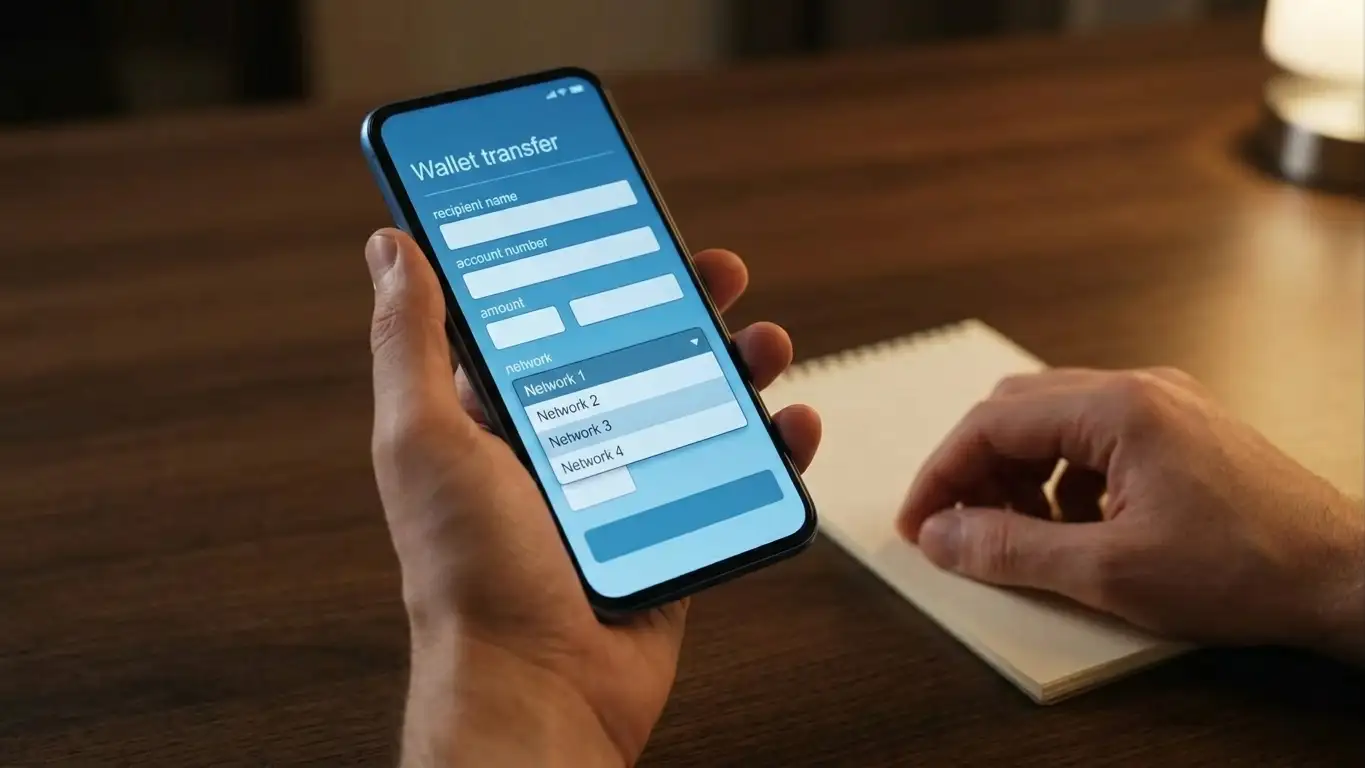
The chain you send on decides what the deposit costs
USDT is not one token. It is the same dollar claim issued separately on a dozen blockchains, and the versions are not interchangeable. Tron carries roughly $92.28 billion of it and Ethereum roughly $73.43 billion as of early September 2026, which between them is most of the supply in existence — that concentration is exactly why casino cashiers default to those two and treat the rest as optional extras.
When you open a cashier and pick USDT, the site generates a deposit address for one specific network. Send to that address from a wallet configured for a different chain and the funds do not arrive late. They arrive nowhere. Recovery depends on whether the receiving address exists on the chain you used and whether anyone controls the private key for it, which in a casino’s custodial setup usually means a support ticket and a long wait, if it is possible at all.
The cost difference between the four realistic options is not marginal. Priced as a percentage of a modest Australian deposit, it becomes the single largest controllable expense in the whole exercise.
| Network | Typical fee per send | Settlement | Casino cashier support | When to use it |
|---|---|---|---|---|
| TRC-20 (Tron) | $0 to $3.50, sub-cent with staked TRX | About 3 seconds per block | Near universal | Default choice for almost every deposit |
| ERC-20 (Ethereum) | $2 to $20, up to about $100 at peak congestion | Minutes | Universal | Only when you already hold ERC-20 and the amount is large |
| BEP-20 (BNB Chain) | Cents | Seconds | Common but not guaranteed | Cheap alternative, only if the cashier lists it explicitly |
| Solana (SPL) | Under $0.001 | Seconds | Thinnest of the four | If you already hold SPL USDT and the site accepts it |
Run the arithmetic on a A$150 deposit, which is a fairly ordinary Friday-night figure. At roughly parity that is about 100 USDT. An $8 Ethereum gas fee on that transfer is 8% of the deposit gone before a reel spins — worse odds than the house edge on most pokies, paid voluntarily, for nothing. The same transfer on Tron with staked energy costs a fraction of a cent. On Solana, less than that. Nobody hands out that money back to you later.
USDT on Tron (TRC-20) — the default worth taking
Tron holds the largest single deployment of USDT on any chain, about $92.28 billion at the start of September 2026, and settles blocks in roughly three seconds. Every casino cashier in the list above credits TRC-20. That combination of universal acceptance and near-zero cost is why the industry converged on it, and why a first-time Australian depositor who does nothing else right will still be fine if they pick this one.
The fee range needs a small caveat. A raw TRC-20 transfer without staked TRX can cost up to a few dollars, because Tron charges energy for contract execution and you either stake TRX to generate it or pay in burned TRX. Most exchanges absorb this into a flat withdrawal fee, so what you actually see is a fixed charge of a dollar or two per send, not a variable one. If you are moving USDT often, staking a small amount of TRX in a self-custody wallet drops the cost to effectively nothing — worth ten minutes of setup if this is a habit rather than a one-off.
USDT on Ethereum (ERC-20) — universally accepted, quietly expensive
Ethereum carries about $73.43 billion of USDT and every cashier takes it. On paper that makes ERC-20 the safest possible choice, and for institutional-sized transfers it genuinely is: a $20 fee on a $50,000 movement is noise, and Ethereum’s settlement assurances are the strongest of the four.
For casino deposits it is close to the worst option available. Transfers run $2 to $20 in normal conditions and have spiked toward $100 when the network is busy, and busy is not something you can schedule around. Australians get caught by this most often when they buy USDT on an exchange, accept whatever network the withdrawal screen defaults to, and only notice the fee after it is deducted. Check the network dropdown. It takes four seconds and it is the highest-return four seconds on this page.
USDT on BNB Chain (BEP-20) — cheap if the cashier lists it
BEP-20 fees sit in the cents and finality comes in seconds, which puts it in the same practical bracket as Tron for cost. Several operators here support it — Stake, Cloudbet, Thrill, JackBit and Betpanda among them — and where it is supported there is nothing wrong with using it.
The risk is acceptance rather than cost. Support for BEP-20 is common but not universal, and a cashier that lists “USDT” without naming networks is a cashier you should not guess at. If the deposit screen offers a network selector, read it. If it does not, and the address begins with a T, that is Tron and you send Tron. The classic loss in this market is not a hack or a rigged game. It is somebody sending BEP-20 USDT to a TRC-20 address at two in the morning and discovering that blockchains do not have a customer service department.
USDT on Solana — the cheapest send you probably can’t use yet
Solana moves USDT for under a tenth of a cent and confirms in about the time it takes to read this sentence. On pure economics it wins outright, and the gap over Tron is real if you are transferring frequently in small amounts.
Cashier support is the bottleneck. Stake takes SPL USDT; most of the rest do not, or bury it behind a separate coin listing. So the honest recommendation is narrow: if you already hold USDT on Solana and your chosen site accepts it, use it and enjoy the cheapest deposit in the market. If you do not, bridging into Solana purely to save a dollar on a network fee is a lot of moving parts for very little money, and every extra step is another chance to send funds somewhere they cannot be retrieved.
Which USDT network should I use to deposit at a casino — TRC-20 or ERC-20?
TRC-20 on Tron, in almost every case. Fees run from nothing to a few dollars against Ethereum’s $2 to $20, settlement takes about three seconds, and every casino cashier worth using credits it. Reserve ERC-20 for large transfers where the fee is negligible relative to the amount and you already hold Ethereum-network USDT.
What happens if I send USDT on the wrong network to a casino?
The deposit does not arrive and may be unrecoverable. Casino cashiers monitor one specific chain per address, so TRC-20 funds sent to a BEP-20 address sit at a location the operator is not watching and may not control. Some support teams recover these manually; many cannot. Always match the network selector to the address the cashier issued.

Getting USDT with Australian dollars — the leg nobody costs
Every ranking page on this topic begins at the moment you already hold Tether. Australians do not start there. They start with dollars in a bank account and a decision to make about which exchange converts them, and that decision costs more over a year than any casino’s fee schedule.
There is a second, less obvious point. The exchange is the only link in this entire chain that operates under Australian law. Once USDT leaves for an offshore cashier, you are outside AUSTRAC’s remit, outside Australian consumer protection, and outside anything resembling a complaints process. The exchange leg is where your legal standing lives, so it is worth picking a registered one and keeping records.
Bank friction is real and getting worse. The Independent Reserve Cryptocurrency Index found roughly 30% of Australian crypto investors had a transfer to an exchange blocked or delayed by their bank, up from 19.3% a year earlier. PayID deposits usually sail through where a card purchase or an international transfer would not, which is a practical argument for the local platforms over an offshore venue.
The pricing models differ in a way the marketing does not make obvious. An order-book exchange charges a visible trading fee — CoinSpot’s spot market runs 0.1%, Independent Reserve’s tiers start around 0.50%. A broker-model platform like Swyftx quotes you a price with roughly 0.6% built into the spread, so there is no fee line to read and the cost is invisible. On $10,000 of monthly buying, the difference between 0.1% and 0.6% is about $50 a month, or $600 a year. No casino’s withdrawal fee comes anywhere near that.
CoinSpot
An Australian exchange, AUSTRAC-registered, ISO 27001-certified, and the default first account for a large share of local crypto buyers. AUD arrives by PayID and typically credits within minutes, the interface asks almost nothing of you, and USDT can be withdrawn on several networks with the chain selectable at withdrawal.
The catch is structural and costs people real money. CoinSpot runs two purchase paths: an instant-buy button that is convenient and materially expensive, and a spot market that charges 0.1% and takes about thirty extra seconds to use. New users click the button. If you plan to buy USDT more than once, learn the spot market — the saving on a single A$500 purchase covers the mild inconvenience several times over, and it compounds every time after that.
Swyftx
Brisbane-based, AUSTRAC-registered, ISO 27001, and the best-built app in the local set. Swyftx operates as a broker: it quotes a single price with about 0.6% embedded in the spread, so there is no separate fee to calculate. Over 320 assets, strong educational material, and the smoothest path for somebody who has never touched an order book.
That 0.6% is the whole trade-off. For a player converting A$200 a month it amounts to a bit over a dollar — genuinely not worth optimising. For anyone cycling four figures regularly it is the most expensive line item in their gambling, and it does not appear on any statement as a fee. Swyftx is the right pick for convenience at small volume and the wrong pick at large volume, and knowing which of those you are is worth thirty seconds of honesty.
Independent Reserve
Sydney-based, running since 2013, AUSTRAC-registered, and the most institutionally serious of the local options. It is an order book with tiered fees starting around 0.50% and falling with volume, plus an OTC desk for larger sizes and AUD, USD and NZD pairs. No major security incident in over a decade of operation, which in this sector is a genuine distinction rather than a marketing line.
It is also the source of the most useful Australian data point on this page — its own Cryptocurrency Index is where the 30% bank-blocking figure comes from. For a USDT player, the practical appeal is predictability: order-book pricing you can see, deep AUD liquidity, and an OTC route if you are moving amounts where spread starts to bite. The interface expects a little more of you than Swyftx does, and that is the entire cost.
Kraken Australia and Binance’s local entity
Both operate through Australian entities registered with AUSTRAC and both offer AUD rails. What they bring over the domestic platforms is depth: the deepest USDT order books available to Australians, the lowest per-withdrawal network fee tiers, and the widest choice of chains at the withdrawal screen — TRC-20, ERC-20, BEP-20, Solana and more, selectable rather than assumed.
For anyone moving USDT regularly, this is where the cost floor sits, because the saving lands on both the trade and the network fee. Verification is heavier and the interfaces are built for traders, not first-timers. One thing worth checking rather than assuming: AUSTRAC deregistered nine digital currency exchanges in a single quarter, so “registered” is a status to confirm on the register, not a permanent property of a brand name.
Do I have to pay tax on USDT casino winnings in Australia?
Recreational gambling winnings are not taxable income in Australia. The crypto legs are a separate matter — the ATO treats USDT as a CGT asset, so buying it with AUD and selling it back are disposal events on the token itself. The ATO has data-matched Australian exchange records since 2014–15, so keep your transaction history.

The legal position, stated properly
This part gets mangled almost everywhere, usually in the direction of reassurance. The accurate version is more interesting than the comfortable one.
Online casino gaming — pokies, roulette, blackjack, baccarat, live dealer tables — is a prohibited interactive gambling service in Australia under the Interactive Gambling Act 2001 (Cth). The 2026 country chapter of the ICLG gambling guide states it without qualification: online casino gaming is prohibited under the Act. What matters for you specifically is where the prohibition attaches. The Act makes it an offence to provide a prohibited service to a person in Australia. It does not criminalise the person placing the bet. Australians have never been prosecuted for depositing at an offshore casino, and there is no provision under which they would be.
So the honest summary: the operator is breaking Australian law by serving you, and you are not breaking it by playing. That is a materially different situation from “it’s legal” and from “you’re committing a crime,” and both of those framings appear on ranking pages that should know better.
Why there is no Australian-licensed USDT casino
No Commonwealth or state licence exists for online casino product. State regulators — Liquor & Gaming NSW, the VGCCC, Queensland’s OLGR — licence land-based venues, lotteries and online wagering on racing and sport. That is the complete list of legal Australian online gambling. Sportsbet, TAB and Ladbrokes hold real Australian licences and offer no casino games at all, which is not an oversight on their part.
The crypto side is closed off by a separate rule, and this is the piece that explains the whole market. Since 2024, Australian-licensed wagering operators have been prohibited from accepting credit cards, credit-related products and digital currency as payment. Even the legal Australian operators cannot take Tether, by law. Which means USDT casino play is not offshore because offshore sites happen to be more crypto-friendly. It is offshore by construction — the legal Australian side is barred from the payment method and the product simultaneously.
Anyone advertising an “Australian licensed USDT casino” is either confused or lying, and the second is more likely.
What the offshore licence on the footer is worth
Less than it did, and the reason is a specific regulatory change. Curaçao’s National Ordinance on Games of Chance — the LOK — came into force on 24 December 2024 and killed the old master-licence model, in which a handful of holders like Antillephone N.V. issued sub-licences to hundreds of operators. Those legacy sub-licences expired in January 2026. Licensees now hold direct numbers from the Curaçao Gaming Authority, must maintain a physical presence on the island as of 1 January 2026, and face full supplier licensing enforcement when the transitional period closes on 24 December 2026.
This gives you a free diagnostic. A footer showing a modern CGA number in the OGL/2024/… format — Stake’s OGL/2024/1451/0918, BitStarz’s OGL/2024/165/0185 — reflects a licence issued under the current regime and checkable on the CGA portal. A footer still showing an 8048/JAZ… Antillephone number in 2026, as Katsubet and Mirax have, points at a model that no longer exists. It does not automatically mean the site is unlicensed; brands were slow to update footers. It does mean you should verify before depositing rather than after.
Anjouan deserves a flag of its own, because a large share of crypto brands migrated there when Curaçao tightened up. It is the cheapest and fastest licence widely marketed, with roughly 1,300 claimed licensees as of June 2026, and it is the one jurisdiction where the register itself is the problem. ABC News reported in December 2025 on operators issuing fake corporate licences in Anjouan’s name. The Comoros vice-president described an earlier iteration of the regime as money-laundering operations back in 2007. An Anjouan badge with no traceable registry entry is a graphic, not a regulator.
Which reframes the whole trust question. Licence jurisdiction used to be the signal; licence verifiability is the signal now. A number you can look up beats a prestigious-sounding acronym you cannot.
What happens when your casino’s domain stops loading
The ACMA has had 1,751 illegal gambling and affiliate websites blocked at ISP level since November 2019, with roughly 230 more services withdrawing from the Australian market rather than face it. Blocking continues in batches, and the named targets are exactly the crypto-friendly brands this topic covers — Lucky Mate, Vegastars, Wombet, Cosmobet, Fortune Play, Fortunica, Rolletto, Velobet, 7Signs, Chromabet among them. The regulator’s 2026–27 compliance priorities keep illegal offshore casino and its advertising pathways on the list, and it has publicly warned platforms carrying illegal crypto-casino ads.
The practical consequence for you is that domain instability is a structural feature of this market, not bad luck. Sites run numbered mirrors because they have to. Your balance is generally unaffected by a block — the account survives, the address you used to reach it does not — but if you cannot log in you also cannot withdraw, and a mirror domain is exactly the shape a phishing clone takes. The BC.Game situation illustrates the danger: a bc-game.cam clone was exposed as unlicensed and running fake game feeds. Bookmark the domain you actually funded, verify any replacement through the operator’s own support channel, and never chase a login through a search ad.
Is it legal for an Australian to gamble with USDT at an offshore casino?
The Interactive Gambling Act 2001 puts the offence on the operator for supplying online casino games to Australians, not on the player for using them. No Australian has been prosecuted for depositing at an offshore casino. You are not committing a crime; you are also outside every Australian consumer protection, with no ombudsman and no chargeback.
Why did the USDT casino site I used last year stop loading in Australia?
The ACMA has had 1,751 gambling and affiliate sites blocked by Australian internet providers since November 2019, and blocking continues in batches. Your account and balance normally survive a block, but the address does not. Verify any replacement domain through the operator’s own support channel — mirror links are prime territory for phishing clones.

The operators in detail
Order below follows relevance to a USDT player specifically: network coverage, verifiable licence, payout behaviour, terms transparency. It is not ordered by bonus size, which is how most lists are sorted and part of why they are useless.
Stake
Operated by Medium Rare N.V. under Curaçao Gaming Authority licence OGL/2024/1451/0918, trading since 2017, with more than 10,000 titles from Pragmatic Play, Hacksaw, Evolution and a long bench of others, plus its own in-house Originals. The licence number is the modern direct format, issued under the current regime and checkable — which, given how many competitors are still displaying expired sub-licence formats, counts for more than it sounds.
For a USDT player the pull is payout speed and network breadth. Stake credits TRC-20, ERC-20, BEP-20 and Solana, so whatever chain your exchange defaults to, it works. Third-party testing has clocked crypto withdrawals clearing in under two minutes, which is the fastest verified figure in this cohort rather than a marketing claim. Withdrawals carry a 1x deposit turnover requirement — you cannot deposit and immediately withdraw untouched funds, which is standard anti-laundering hygiene rather than a trap. The rewards model runs on rakeback and VIP tiers instead of headline match bonuses, so if you are shopping for a “500% welcome package” you will find this dull. If you are shopping for money that arrives, it is the benchmark. Most Australians know the name from sports sponsorship, which creates a false sense of local legitimacy worth resisting: the brand is familiar, the legal standing here is nil.
Cloudbet
A long-running crypto sportsbook and casino with a high-limit orientation, licensed in Curaçao. Two features make it the most quietly grown-up option on this list. Its terms name an independent dispute-resolution route — rare enough offshore to be worth the whole entry — and it publishes an actual fee schedule instead of hiding behind vague “processing charges.” Once an account is fully verified there is no stated withdrawal ceiling.
For an Australian with no ombudsman, no chargeback and no regulator to complain to, a named dispute path is worth considerably more than an extra hundred per cent on a deposit match. Cloudbet also holds stablecoin balances natively, so a USDT bankroll stays denominated in USDT rather than being converted into house credits at a rate you have to reverse-engineer. The live dealer section carries high table limits, which suits the account sizes this site is built for and matters less if you are playing A$2 spins. Bonus generosity is mid-pack. Deliberately so, and the trade reads well.
BitStarz
Gareton B.V., Curaçao Gaming Authority licence OGL/2024/165/0185, live since 2014 — the longest continuous track record in this group. Around 6,500 games with a pokies-forward catalogue heavy on Megaways and Hacksaw titles. Historically part of the Dama N.V. brand family, which puts it in the same lineage as 7Bit, Woo, King Billy and Katsubet, and it sits inside the broader migration wave from Curaçao toward Anjouan that is worth watching rather than treating as settled.
The bonus structure is the most instructive thing here, because BitStarz documents its fine print more clearly than its rivals. The welcome package spreads up to AU$10,000 across four deposits, opening with a 100% match up to AU$400 or 1 BTC plus 500 free spins. Verifying your email releases 20 free spins before you deposit anything — the “free” part comes with winnings capped at AU$150 and frozen until you top up A$20. Read that sentence twice, because it is the whole business model in miniature: nothing here is a gift, it is an option contract you pay for with a deposit. Crypto cashouts usually land within the hour, and USDT support covers TRC-20 and ERC-20 rather than the full spread.
mBit Casino
Founded in 2014 as one of the original Bitcoin-first casinos, now multi-coin including USDT, Curaçao-licensed. The licence lineage predates the LOK, so the number in the footer is one to check against the CGA portal rather than trust at face value — a general rule for any brand older than the 2024 reform.
Its distinguishing strength is the live dealer section, which is genuinely deeper than most crypto-native sites manage, and it runs a fiat cashier alongside crypto — unusual for a brand of this vintage and useful if you occasionally want to bypass the exchange leg entirely. Current welcome terms run 150% plus 100 free spins. There is a specific quirk worth knowing before you sit at a live table with a stablecoin bankroll: live dealer limits are priced in US dollars, so a USDT balance maps to them 1:1 while an AUD mental model drifts with the exchange rate. A table with a $500 maximum is a $500 maximum whether you think in Australian dollars or not, and players who budget in AUD routinely misjudge their exposure by the size of the currency gap.
7Bit Casino
Launched 2014, operated by Dama N.V. — the same parent behind BitStarz, Woo Casino, King Billy and Katsubet. Curaçao-licensed, 3,000-plus titles, retro-styled front end, pokies-heavy catalogue, and the most aggressive bonus schedule in this group: packages in the region of 325% up to $5,400 plus 325 free spins, recurring reloads, and an eight-tier VIP structure of the type used across the family.
That shared parentage is the reason 7Bit is here, and it is a point no ranking page makes. If your shortlist contains 7Bit, BitStarz and Katsubet, you have not diversified across three operators — you have one operator’s payout policy, terms template and risk posture, counted three times. When something goes wrong at the group level, it goes wrong everywhere at once. As for the bonuses: a 325% match sounds enormous until you multiply the bonus amount by the wagering requirement and work out the turnover needed to release it. Do that calculation before the deposit, not after. It is arithmetic, not pessimism.
Thrill
Around 1,500 casino titles plus in-house Originals and a sportsbook, offshore-licensed, younger and smaller than the 2014 cohort — which means licence verification matters more here, not less. Public track record is thinner than the veterans’, and that is stated rather than smoothed over.
What earns it the entry is the reward model, which is structurally better than what the big-bonus sites offer and almost nobody explains why. Thrill returns up to 70% rakeback plus 10% cashback instead of a headline deposit match. Rakeback pays a slice of your turnover back with no wagering requirement attached, so it is money, not a conditional credit. Compare honestly: a 300% match at 40x wagering on a 100 USDT deposit hands you 300 USDT of bonus that requires 12,000 USDT of turnover to release, which most bankrolls will not survive. A wager-free rakeback percentage on that same turnover pays out continuously and cannot be voided by a terms breach you did not read. For anyone who plans to cycle a bankroll rather than gamble a single deposit, the maths is not close.
JackBit
Crypto casino plus a large sportsbook — 6,000-plus casino titles, 40-plus sports leagues including a solid esports book — offshore-licensed, marketed hard on instant withdrawals and no KYC, with rakeback tiers reaching around 30% at the top end. Verify the licence number before depositing. The no-KYC brands are precisely where licence claims are thinnest.
It is on this list as the cautionary case, and the reason is a documented gap between marketing and practice. JackBit’s no-KYC positioning is contradicted by a recurring pattern of verification demands appearing at cashout — after the money is in, when the leverage has moved. Its Trustpilot standing sits around 1.7 out of 5. That gap is the single most useful thing to understand about the entire no-KYC category, and JackBit happens to be the clearest example of it. The sportsbook is genuinely good and the site is fast when nothing gets flagged. Both of those things can be true while the withdrawal experience is the part that decides whether any of it mattered.
Betpanda
Launched 2023, 5,000-plus games plus a sportsbook, crypto-only cashier, VPN-tolerant, and positioned entirely on privacy: no ID to register, deposit, play or withdraw. Zero-fee framing on transactions, 10% weekly cashback with no stated maximum, 100% match up to 1 BTC, and a minimum deposit low enough to be a rounding error.
Here is the part that has to be said plainly, because most write-ups of this brand skip it. No UKGC, MGA, Curaçao or Anjouan licence is traceable for Betpanda in any public registry. SSL, certified game feeds and provably fair mechanics are technical measures, not regulatory ones — they tell you the software is real, not that anyone will make the operator pay you. If a withdrawal is refused, there is no regulator to complain to, no dispute body named in the terms, and no jurisdiction in which to pursue it. That is the trade in its clearest form: maximum anonymity, maximum speed, zero recourse. Plenty of people take that trade knowingly and have a fine time. Taking it unknowingly is the problem, and it is why this entry exists at all rather than being quietly dropped from the list.
Katsubet and Mirax — the sibling-brand problem
Katsubet has been running since 2020, carries around 5,000 titles, advertises instant crypto withdrawals, and is genuinely popular with Australian crypto players — it is one of the more visible AU-facing brands in this space. Mirax runs a comparable pokies-led library with no-deposit spin offers. Both are Curaçao-licensed and both sit on legacy Antillephone numbers: Katsubet on 8048/JAZ2020-013, Mirax on 8048/JAZ2019-015.
Those numbers are the lesson. The 8048/JAZ format belongs to the master-and-sub-licence model that the LOK abolished, with old sub-licences expiring in January 2026. A site still displaying that format has either not updated its footer or has not transitioned — and from the outside you cannot tell which, which is exactly why the CGA portal exists. Check before you deposit. The second lesson is the one from 7Bit: Katsubet belongs to the Dama N.V. family, so choosing Katsubet and BitStarz and 7Bit is a single decision wearing three hats. Both sites are reasonable places to play pokies with USDT. Neither is an independent hedge against the other.
BC.Game — why last year’s list is not this year’s list
Enormous by any measure: 8,000-plus games, 18-plus cryptocurrencies including Monero, the widest USDT network coverage in this group, a strong provably fair Originals catalogue, a 470% staged welcome package with 400 free spins, and a large social layer around it.
It also relinquished its Curaçao licence in December 2024, one day before the island’s Gaming Control Board was scheduled to rule on its status, publicly citing an increasingly hostile environment and a pivot toward regulated markets. Complaint trackers aggregate more than $2.1 million in reported unpaid claims. And a bc-game.cam clone was exposed running fake or unauthorised game feeds under the brand’s name. Most of the pages currently ranking for this topic still print BC.Game as Curaçao-licensed, which tells you how much of the ranking industry re-checks anything. That is the actual reason this entry is here — not as a recommendation, but as the standing demonstration that licence status is a thing you verify today rather than inherit from a list somebody compiled in 2023.
Can I really play at a USDT casino with no KYC?
Up to a point, then no. No-KYC in practice means risk-based verification: no ID to register, deposit, play and withdraw below a threshold. Exceed it, trigger a fraud rule, or request a large cashout and documents get requested — often at withdrawal, which is when the operator holds the leverage.

How fast the money actually comes back
“Instant withdrawals” appears on essentially every page in this market and means almost nothing, because it describes one stage of a three-stage journey and not the slow one. Break the trip into its parts and the claim falls apart usefully.
Stage one is operator approval. This is the only genuine variable. At a site with automated payouts and a clean account, approval happens in seconds. At a site with manual review queues, weekend staffing gaps, or a risk rule your withdrawal happened to trip, it takes hours or days. The verified benchmark in this cohort is Stake, clocked under two minutes in third-party testing. One documented test account across a dozen withdrawals showed a median of three hours twelve minutes from pressing the button to funds landing, with the fastest at 58 minutes on USDT — a realistic picture of the middle of the market rather than the marketing edge.
Stage two is chain confirmation, and it is trivial. Seconds on Tron and Solana, minutes on Ethereum. This is the stage everyone optimises and it is worth optimising least.
Stage three is turning USDT back into Australian dollars, which is where the time nobody mentions actually goes. Your USDT lands at the exchange, waits for the exchange’s own deposit confirmations, gets sold for AUD, and then moves through Australian banking rails. Same-day is normal. Same-hour happens. A Friday-evening withdrawal that clears the casino in two minutes can still sit until Monday if your bank decides to look at it, and roughly 30% of Australian crypto investors have had a transfer blocked or delayed at some point, so this is not an edge case.
The conclusion competitors miss by conflating stages: choosing TRC-20 cannot rescue a site that reviews withdrawals by hand. Payout speed is an operator-policy variable dressed up as a blockchain feature. Pick the operator for speed and the network for cost, and stop expecting either to fix the other.
How long does a USDT withdrawal actually take to reach my Australian bank account as AUD?
Realistically, hours rather than minutes. Operator approval runs from under two minutes at the fastest sites to a day where manual review intervenes, chain confirmation adds seconds, and the exchange-to-AUD leg usually settles same-day. Bank scrutiny is the wildcard — plan on same-day and accept that weekends stretch it.
Anonymity, ID checks and what “provably fair” actually covers
Two claims dominate the marketing in this corner of the market and both need trimming.
The first is no-KYC. There is no permanently anonymous licensed casino in 2026, and the honest translation of the phrase is risk-based verification with a deferred trigger. You register, deposit, play and withdraw without documents up to a threshold defined by the operator’s internal rules and never published. Cross it — through cumulative volume, a single large cashout, a bonus-abuse flag, or a VPN pattern their system dislikes — and documents get requested. The timing is what matters: verification arrives at withdrawal, not at deposit, because that is when the operator holds your money and you hold nothing. JackBit is the documented case, not the exception.
There is a structural trade-off buried in this that deserves naming. The sites most willing to skip identity checks are systematically the ones least likely to carry a verifiable licence, because the two things flow from the same regulatory posture. Betpanda takes no ID and has no traceable licence. That is not a coincidence and it is not a scandal — it is the same decision viewed from two angles. You can have anonymity or you can have recourse. Vendors who promise both are selling one and calling it two.
The second claim is provable fairness, which is real and narrower than it sounds. Provably fair mechanics apply to in-house RNG originals — dice, crash, plinko, mines, limbo — where the operator publishes a server seed and you can verify after the fact that the result was not tampered with. It does not apply to a Pragmatic Play pokie, a Hacksaw title, or an Evolution live table, because those run on third-party servers under third-party audit. A site advertising “provably fair” while its catalogue is 95% licensed third-party pokies is telling you the truth about 5% of its games. Useful truth, narrow scope.
For Australians there is a third consequence, and it is the one that matters most. BetStop — the National Self-Exclusion Register established under the Interactive Gambling Act — binds Australian-licensed wagering providers only. A Curaçao or Anjouan licensee has no obligation to check it and no mechanism to do so. Bank-level gambling blocks, which several Australian banks now offer, work by declining transactions to merchant category codes for gambling; a purchase of USDT on an exchange is not coded as gambling, so the block does not see it. Card declines, deposit limits, the whole apparatus of friction that exists to slow people down — crypto rails route around all of it. If you rely on those tools, understand that using USDT switches them off.

Bonuses on a stablecoin balance — read the denomination
Bonus terms are the least important variable on this page and the most heavily marketed, which is not a coincidence. Still worth getting right, because two specific things go wrong when a bonus meets a stablecoin bankroll.
The first is denomination drift. Offers displayed to Australians are frequently quoted in AUD — “up to AU$10,000” — while the balance itself, the wagering requirement and the maximum bet per spin are administered in US dollars, because that is what a USDT balance is. A $5 maximum bet while a bonus is active is not A$5. Exceed the cap in AUD terms because you were thinking in AUD terms and the bonus can be voided along with any winnings from it, which is a genuinely common way for people to lose a payout they thought they had earned.
The second is the arithmetic. Take a 300% match at 40x wagering on a 100 USDT deposit: 300 USDT of bonus credit requiring 12,000 USDT of turnover before anything releases. At a 3% house edge on the eligible games, the expected cost of generating that turnover is around 360 USDT — more than the bonus is worth. That is not a trick question or a rounding error, it is the design. The “gift” is a coupon that costs more to redeem than it pays, and the casino is not running a charity fundraiser with your Friday night.
| Operator | Headline offer | Wagering | What clearing it really costs | Verdict |
|---|---|---|---|---|
| Thrill | Up to 70% rakeback + 10% cashback | None on rakeback | Nothing beyond normal play | Best structure here — money, not credit |
| Stake | Rakeback and VIP tiers | 1x deposit turnover on withdrawal | Negligible | Boring and honest |
| Cloudbet | Mid-sized match | Mid-range multiplier | Moderate turnover | Fair, and the fee schedule is published |
| BitStarz | Up to AU$10,000 across 4 deposits + 500 spins | Standard multi-tier | Heavy turnover across four deposits | Only if you were depositing four times anyway |
| 7Bit Casino | Around 325% up to $5,400 + 325 spins | High multiplier | Turnover most bankrolls won’t survive | Big number, poor expected value |
| Betpanda | 10% weekly cashback, no stated max | None stated on cashback | Nothing | Good terms, no licence behind them |
The no-deposit and free-spin corner of this market needs one honest correction. Demo pokies do not involve USDT at all — they run on play credits with no deposit, no withdrawal and no cash outcome, so “free USDT slots” describes a thing that does not exist in the way the phrase implies. Genuine no-deposit offers are real but small, capped, and locked behind a subsequent deposit, as BitStarz’s 20 email-verification spins with an AU$150 winnings cap and a A$20 unlock requirement demonstrate neatly.
Pokies, live tables and what a USDT balance changes about them
Pokies on a USDT bankroll
Nothing about a pokie changes because your balance is denominated in Tether. Same Pragmatic Play and Hacksaw titles, same RTP, same volatility, same certified RNG. What changes is the accounting around it: you are betting in a unit pegged to the US dollar, so a A$100 session is not a $100 session, and stake increments that feel round in AUD are awkward in USDT. Players who track their results carefully find this annoying. Players who do not track their results find it expensive.
Catalogue size is where the operators diverge, and the numbers are less meaningful than they look. BC.Game’s 8,000-plus and Stake’s 10,000-plus titles versus Thrill’s 1,500 sounds like a decisive gap until you notice that beyond a few hundred games nobody plays the tail. What actually matters is whether the studios you want are present — Hacksaw, Nolimit City, Pragmatic, Push Gaming — and whether the site’s provably fair Originals interest you, since those are the only titles where the fairness claim is verifiable.
Live dealer, roulette and blackjack
Live dealer access is a real differentiator and it is not universal. Evolution feeds are not available to every offshore operator, and the sites that have them — Stake, mBit, Cloudbet — offer a materially different product from the ones running second-tier live providers. mBit’s live section is the deepest of the crypto-native veterans, and Cloudbet is the one built for high limits.
Then there is the denomination quirk, which applies specifically to live tables and is worth more than the rest of this section. Live limits are set in US dollars. A USDT balance maps to them exactly, one for one, which is arguably the strongest practical argument for a stablecoin over Bitcoin at a live table: the minimum on that blackjack seat is $5 and it stays $5, rather than shifting every time the coin moves. Australians budgeting mentally in AUD are the ones who get caught, because the table limit they read as “about seven and a half dollars” is a US-dollar figure and their exposure is larger than they think by the whole currency gap.

USDT against the alternatives — PayID, Bitcoin, Ethereum
The comparison that decides whether any of this is worth the trouble.
Against PayID, USDT wins on availability and loses on almost everything else. PayID moves Australian dollars from an Australian bank to an Australian recipient in seconds, free, with your bank’s protections attached and no chain to select. Its problem is that offshore casinos increasingly cannot take it — payment processors serving prohibited services get cut off, PayID rails get closed, and the deposit method that worked in March stops working in September. USDT does not have that failure mode, because there is no processor to cut off. So the honest framing: if a site you trust accepts PayID and you are depositing A$100 for a Friday night, PayID is the better instrument and the crypto detour is overhead you do not need. If you are depositing regularly, want payouts that do not depend on a processor’s continued cooperation, or care about not having gambling transactions on your bank statement, USDT earns its complexity.
Against Bitcoin and Ethereum, USDT’s case is narrow and solid: your balance does not move. Deposit 500 USDT, win nothing, withdraw 500 USDT, and you have 500 dollars’ worth. Deposit 0.005 BTC and a routine 5% market swing means the same outcome hands you back a different amount of money — sometimes more, sometimes less, always outside your control. For a bankroll you intend to cycle over weeks, that volatility is noise you are not being paid to carry. There is one real counter-case: on a long hold in a rising market, BTC’s volatility is the point, and people who won on BTC in 2020 and cashed out in 2021 were not wrong to prefer it. That is an investment position wearing a gambling costume, though, and worth recognising as such.
One institutional note, since it comes up. USDT’s supply sits at roughly $183 to $190 billion depending on the measurement date, with Tether’s Q1 2026 attestation prepared by BDO showing $191.77 billion in assets against $183.54 billion in liabilities — an $8.23 billion surplus, with around $141 billion in US Treasury exposure. The peg has held for over a decade through multiple market crashes and exchange collapses. It was pushed off EU exchanges when MiCA’s transitional period expired on 1 July 2026, which affects European access and has no bearing on Australians. The token is about as boring as a crypto asset gets, and boring is the entire feature.
Is USDT better than PayID for casino deposits from Australia?
For occasional small deposits, no — PayID is faster, free and carries your bank’s protections. USDT wins on reliability and privacy: it cannot be cut off by a payment processor, it keeps gambling off your bank statement, and payouts do not depend on a processor’s willingness to keep serving offshore operators.
How this shortlist was put together
The weights, stated openly so you can disagree with them. Network coverage first, because a cashier that only credits ERC-20 costs you money on every deposit. Licence verifiability second — not jurisdiction prestige but whether the number in the footer resolves to a real entry in a real register, which is now the sharper test. Payout behaviour third, weighted toward measured or documented times rather than marketing claims. Terms transparency fourth: published fees, a named dispute route, wagering requirements stated in plain numbers. Bonus value last, and scored on expected value rather than headline percentage.
Two things were scored as negatives that most lists treat as neutral or positive. Shared ownership is a negative, because a shortlist that unknowingly contains three Dama N.V. brands offers less diversification than it appears to. And newness is a risk rather than a feature. A casino launched last quarter has no payout history, no complaint record and no track record of behaving well when a player wins a large amount — the three things that actually matter. Betpanda’s 2023 launch and Thrill’s short history are both noted in their entries for exactly this reason. New sites often run the loudest promotions precisely because they have nothing else to lead with, and the industry’s steady churn of brands that opened, ran generous offers and quietly stopped paying is not ancient history.
Mobile deserves one paragraph and no more. Every operator here runs a responsive site that works properly in a phone browser, several offer wrapped apps, and the USDT-specific consideration is trivial: pasting a deposit address on a phone is error-prone, so use the QR code your wallet and the cashier both support rather than typing 34 characters and hoping. That is the entire mobile story. Anyone spinning it into a section is padding.
Keeping it boring: limits, blocks and the stuff crypto strips out
The uncomfortable part of this topic is that USDT’s advantages and its risks are the same properties viewed from different angles. No processor can cut you off, which also means no processor is standing between you and a bad decision at 3am. No bank sees the transaction, which also means no bank-level gambling block can stop it. No ID required, which also means no self-exclusion register can reach you. The friction that crypto removes is, to a considerable extent, the friction that was protecting people.
Since the external guardrails are gone, the internal ones have to be deliberate. A few that genuinely work with a stablecoin setup: keep gambling funds in a wallet entirely separate from savings, and never fund it from the same exchange account you hold long-term positions in. Set a per-week conversion amount at the exchange and treat the AUD→USDT purchase as the spending decision, because it is — once the USDT is on a casino site, the decision has already been made. Use the deposit and loss limits the casino offers, even though nobody enforces them on the operator’s side; a self-imposed limit you have to actively remove still adds the pause that matters. And keep records for the ATO, since the exchange legs are CGT events on the token regardless of how the wagering went.
If any of that reads as unnecessary, that is the signal to take it more seriously rather than less. Gambling help is available in every Australian state and territory, free, confidentially, and without a wait. The number is 1800 858 858 and it works nationally.
Crypto Casino Australia 2026 — Bitcoin, Ethereum, USDT, Litecoin & More
Content created by the «CasinoPay» team