
No Minimum Deposit Casino Australia 2026 — The Real List, Withdrawal Traps & Payment-Rail Floors
 Available in AU

Australian punters have been sold the line that a “minimum deposit” is a fixed cost of entry for years. It’s not. The offshore casinos serving Australian players in 2026 compete on how little you can put in, not how much—some advertise no minimum at all, others quietly accept $1 or $5 via PayID or crypto. But the banner figure and the cashier figure rarely match, and the deposit floor is only half the story. The withdrawal floor is where most micro-deposits get locked in.
This guide maps the operators that genuinely allow deposits under A$5, the payment rail that sets the real minimum, the withdrawal trap that turns a $1 deposit into a forced session, and the bonus-qualifying threshold that sits above the stated floor. No affiliate fluff. Tested cashiers, read the terms, requested withdrawals on small balances.
What “No Minimum Deposit” Actually Means in Australia
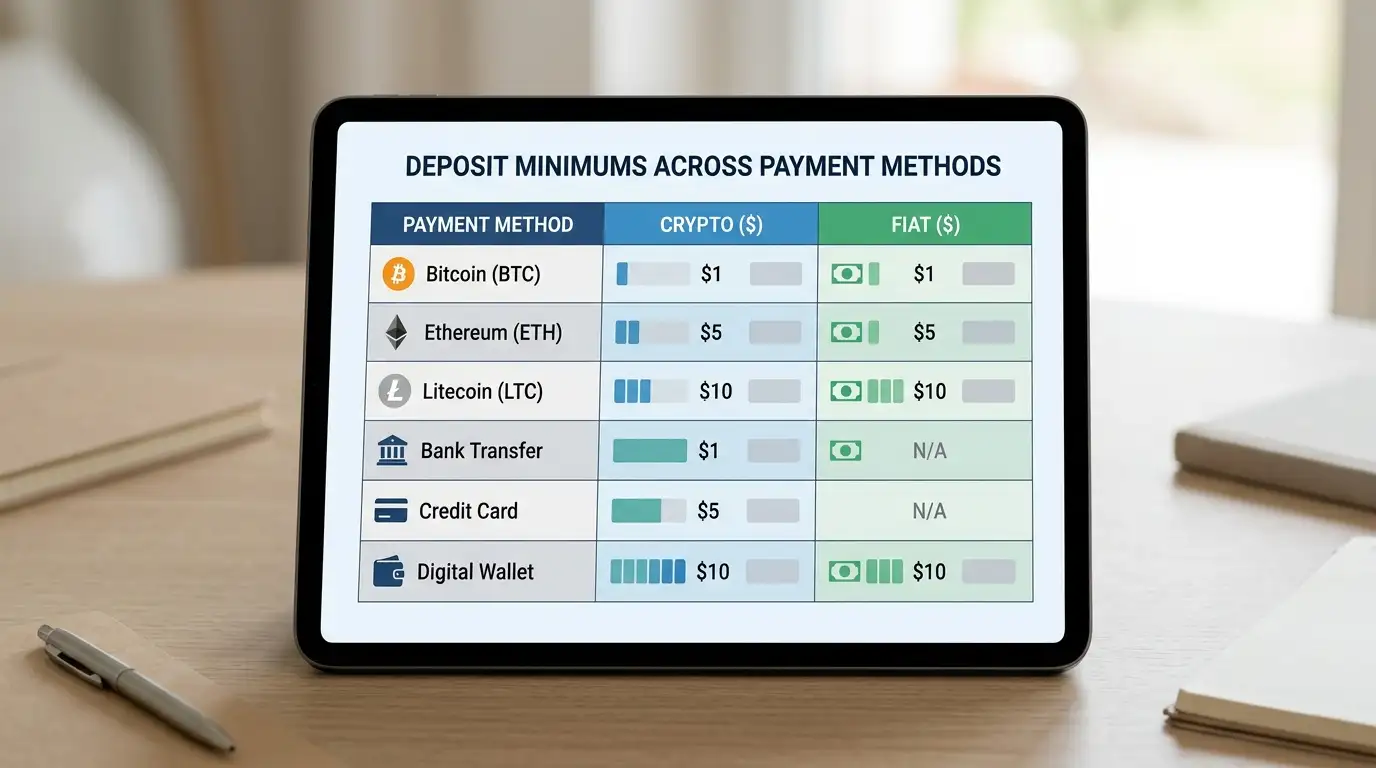
A casino that advertises “no minimum deposit” is making a claim about its cashier policy, not about what your payment method will actually process. The practical floor comes from three layers: the card network or bank rail, the casino’s fraud threshold, and—for crypto—the blockchain’s dust limit. A Visa transaction under $10 often gets rejected by the merchant processor before the casino even sees it. PayID has no technical minimum, but most casinos enforce A$10 or A$20 anyway. Crypto bypasses card-network floors entirely, which is why a $1 deposit in Litecoin clears when the same dollar on a Mastercard bounces.
The phrase “no minimum deposit” usually means “no minimum we enforce beyond what your payment method allows.” That’s not dishonesty; it’s the reality of payment infrastructure. A casino can set its cashier to accept anything, but if your bank or the payment processor says no, the deposit fails. Always check the banking page for the per-method floor, not just the homepage banner.
One more wrinkle: some casinos advertise no minimum deposit but require a separate minimum to qualify for the welcome bonus. You can deposit $1, but the bonus only activates at $20 or $30. That’s not illegal, just annoying—and it’s buried in the bonus terms, not the deposit page.
What’s the difference between “no minimum deposit” and “no deposit bonus”?
A no minimum deposit casino lets you fund your account with as little as the payment rail allows—sometimes $1, sometimes $5, sometimes genuinely no floor at all for crypto. A no deposit bonus gives you free spins or bonus cash without any deposit, though you’ll usually need to deposit later to withdraw winnings. They’re completely different products, but search engines conflate them because punters type both phrases interchangeably. If you’re after a bonus with no money down, that’s a no-deposit-bonus hunt. If you want to fund an account with pocket change, that’s a no-minimum-deposit hunt.
No Australian Licence Exists — What That Means for You
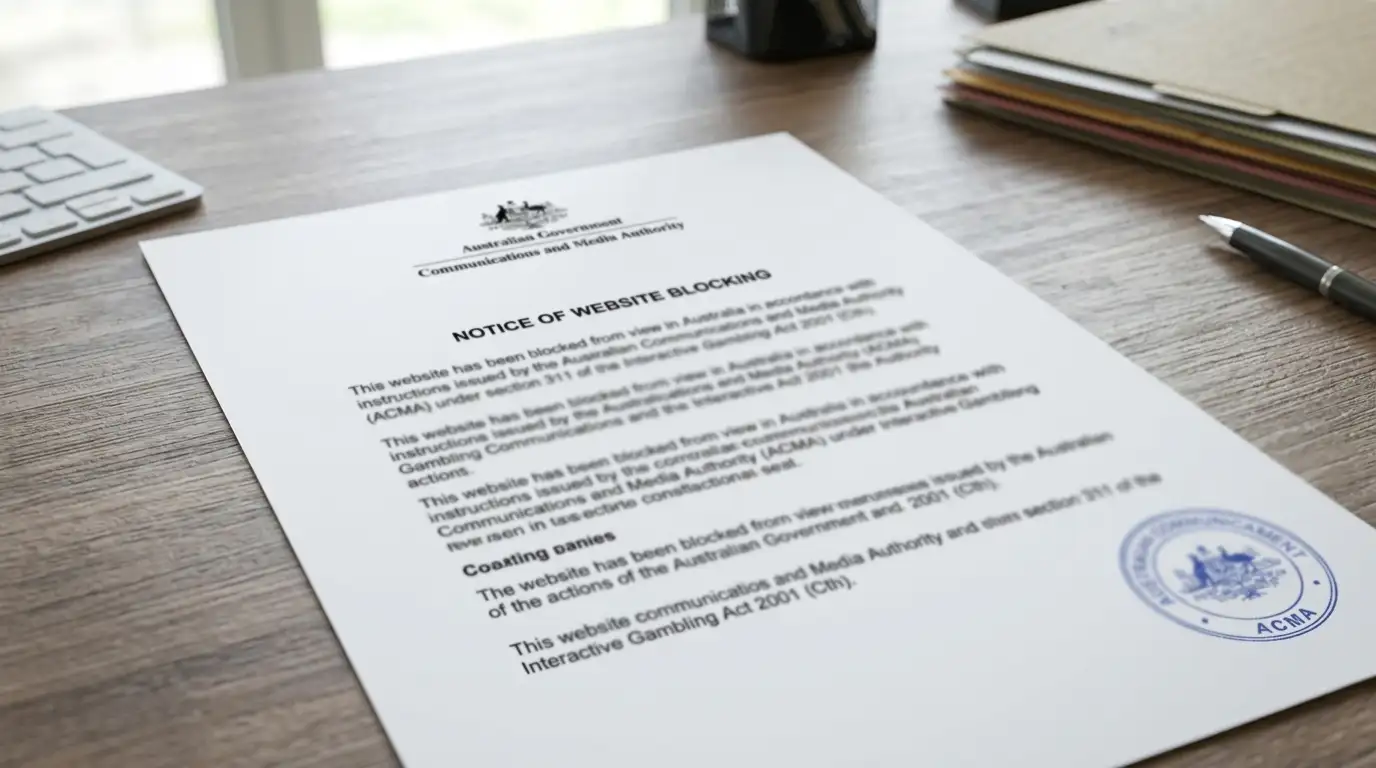
Australia does not issue online casino licences. The Interactive Gambling Act 2001 prohibits the supply of online casino games and in-play sports betting to people in Australia, full stop. It does not criminalise players—you won’t be prosecuted for signing up at an offshore site—but it bans operators from offering the service. That legal structure has created a grey market: hundreds of offshore casinos hold licences from Curaçao, Malta or Kahnawake and accept Australian dollars and Australian players, but none of them is regulated by any Australian authority.
The Australian Communications and Media Authority can block websites, and it has—over 1,700 since November 2019. More than 230 operators have exited the Australian market. The Interactive Gambling Amendment (Gambling Reform) Bill 2026 passed Parliament on 19 August 2026 and commences 1 January 2027. It tightens restrictions on gambling advertising, bans inducement marketing to new signups and at-risk players, prohibits affiliate commissions based on customer losses, and gives ACMA enhanced enforcement powers including ad takedowns. It does not create an online casino licence. So in 2026 and beyond, the only real-money casino option for Australians remains offshore operators licensed elsewhere.
What that means in practice: if a casino refuses to pay, you have no Australian regulator to complain to. You rely on the offshore licence (Curaçao’s regulator has improved in recent years but it’s not ASIC) and the operator’s track record. Stick to brands with at least five years of continuous operation and third-party audit trails. A “no minimum deposit” offer from a two-month-old site with no payout history is not a bargain; it’s a risk you’re taking for a dollar.
Is it legal for Australians to play at no minimum deposit casinos?
Yes, Australian players are not prosecuted for using offshore online casinos. The Interactive Gambling Act targets operators, not players. However, because these casinos are licensed overseas—Curaçao, Malta, Kahnawake—you rely on their licence and reputation rather than Australian consumer law. Choose operators with a long track record (five years minimum), verifiable licences, and documented payout history. If something goes wrong, your recourse is the offshore regulator’s complaints process, not an Australian tribunal.
Casinos With No Minimum Deposit or Under A$5 — The Real List
The table below lists eleven offshore operators accepting Australian players, ordered by deposit floor. The “crypto” column shows the minimum for Bitcoin, Litecoin or similar; the “fiat” column shows the floor for PayID, cards or Neosurf. Where figures conflict across sources, the range is given. Withdrawal minimums are included because they decide whether a micro-deposit is ever cashable.
| Casino | Min Deposit (Crypto) | Min Deposit (Fiat/PayID) | Min Withdrawal | Licence | Distinguishing Feature |
|---|---|---|---|---|---|
| Stake | No minimum ($0.01+) | N/A (crypto only) | ~$1+ | Curaçao | True zero cashier-side floor; instant crypto withdrawals |
| Cloudbet | ~$1 equivalent | N/A (crypto-focused) | ~$10–$20 | Curaçao | Veteran operator since 2013; zero-wagering rewards |
| Roobet | No minimum (dust) | N/A (crypto only) | ~$10 | Curaçao | Dust deposits accepted; fast-growing brand |
| Jackbit | $1–$5 per coin | N/A (crypto focus) | Variable | Curaçao | No-KYC up to ~$5k; 100 wager-free spins |
| Gamdom | ~$1 (LTC/TRX) | N/A (crypto only) | Variable | Curaçao + Anjouan | 15% instant rakeback first 7 days (no wagering) |
| Rainbet | ~$1 (LTC/TRX) | N/A (crypto-focused) | Variable | Curaçao | Low floor; newer brand with momentum |
| BitStarz | ~A$2 equivalent | A$10–A$20 | A$20 fiat, lower crypto | Curaçao | Fiat + crypto hybrid; <10 min crypto withdrawals |
| Red Stag | Crypto accepted | A$5 | A$50–A$100 | Curaçao | Lowest verified fiat minimum; WGS Technology pokies |
| Neon54 | A$10 equivalent | A$10 | ~A$20 | Curaçao | A$10 genuine across all rails including PayID |
| Fair Go | A$10 equivalent | A$10 | A$50–A$100 | Curaçao | Classic AU pokies; consistent A$10 floor |
| King Billy | A$10 equivalent | A$10 | Variable | Curaçao | Five-tier VIP; weekly cashback up to 15% |
All eleven casinos are licensed offshore and not regulated by any Australian authority. None is available through the Australian App Store or Google Play—mobile access is via browser or progressive web app.
Stake — True Zero Minimum
The closest thing to a genuinely “no minimum” casino serving Australians. Stake’s cashier accepts any on-chain amount that reaches your deposit address, even $0.01 equivalent, and Stake Originals (house games) accept micro-bets to match. Operated by Medium Rare N.V. under a Curaçao Gaming Authority licence, launched 2017. The platform supports nine cryptocurrencies including Bitcoin, Ethereum, Litecoin, Dogecoin and XRP, with instant settlement and no cashier-side floor.
Stake’s VIP rakeback program scales by wagering volume, not deposit size, so even $1 deposits accrue rewards. Withdrawals process instantly for crypto (no manual approval delays). No KYC required for most activity, though higher-value accounts may trigger verification. The trade-off is that Stake is crypto-only—no PayID, no Neosurf, no fiat rail at all. If you don’t already hold crypto, you’ll need to buy it elsewhere before depositing.
The house-game RTP on Stake Originals sits around 99%, among the highest in the offshore field. Tracked volume in June 2026 was $2.12 billion monthly, so this is not a fringe operator. The 200% welcome bonus up to $2,000 is generous on paper, but it comes with wagering requirements that a $1 deposit will never clear. Treat the micro-deposit as a test of the withdrawal process, not a bonus hunt.
Cloudbet — Veteran Crypto Operator Since 2013
The longest-running major crypto casino still accepting Australians. Cloudbet has operated continuously since 2013 under a Curaçao licence (Halcyon Super Holdings B.V.), making it the veteran of the field by a wide margin. Minimum deposit is roughly $1 equivalent depending on the coin—the long-standing 0.001 BTC floor no longer applies universally, but practical minimums remain low. Supports 35+ cryptocurrencies.
Cloudbet’s welcome package is structured as zero-wagering rakeback and cash drops rather than a traditional match bonus, which suits micro-stakes players better—there’s no 40x playthrough to clear before you can withdraw. The downside is mandatory KYC for all players, crypto or not, so if you’re after a no-verification experience, look elsewhere. The 2,000+ game library is smaller than newer operators, but the payout speed (sub-10-minute crypto withdrawals tested) and the 12-year track record offset that.
House-game RTP on provably fair titles sits at 99%. Tracked on-chain volume in August 2026 was $49.8 million in 30 days. Minimum withdrawal is around $10–$20 depending on coin, so a $1 deposit that wins $5 won’t reach cashout threshold—plan accordingly.
Jackbit — No-KYC Up to a Threshold
Launched 2022 by Ryker B.V. under a Curaçao Gaming Control Board licence. Jackbit’s headline feature is a no-KYC protocol for crypto players up to a reported threshold of around $5,000 cumulative deposits, after which identity verification is requested. The minimum deposit is $1–$5 depending on coin. The 6,000+ game library from 80+ providers is one of the largest in this comparison, and the 100 wager-free free spins on signup (no deposit needed) are genuinely wager-free—no playthrough, no maximum win cap beyond the standard site limits.
Crypto withdrawals process in 0–1 hour; a tested USDT withdrawal cleared in four minutes. That’s faster than most competitors. Provably fair originals are available for players who want blockchain-verifiable RNG. VIP rakeback scales by volume. The trade-off for the no-KYC model is that once you cross the threshold, verification is mandatory before further withdrawals, and if your documents don’t pass, your balance is locked until they do.
Monthly volume in July 2026 was $9.2 million across 48,000 deposits. The platform supports 16+ cryptocurrencies. If you’re testing a micro-deposit, this is one of the smoothest experiences in the crypto tier, but don’t assume “no-KYC” is permanent—treat it as deferred, not absent.
Gamdom — 15% Instant Rakeback Beats Match Bonuses
Operating since 2016 under Curaçao + Anjouan licences. Gamdom’s minimum deposit sits near $1 equivalent for Litecoin and Tron (tested and verified). The standout feature is 15% instant rakeback for the first seven days with no wagering requirement—every bet returns 15% in cash, no playthrough, no hoops. After the first week it drops into a tiered VIP model with daily surprise rakeback, weekly and monthly rakeback, and immediate-rakeback options, so a slice of every bet comes back regardless of balance size.
For micro-stakes players, rakeback beats match bonuses every time. A $1 deposit with a 100% match gives you $2 total, but 40x wagering means $80 in turnover and a statistical loss of $3.20 at 4% house edge. A $1 deposit with 15% rakeback returns $0.15 for every $1 wagered with no strings—far more useful at small scale.
The 10,000+ game library covers pokies from Pragmatic Play, Evolution live dealer, and provably fair originals. Sports betting and casino share a single wallet. The Anjouan licence supplements the Curaçao base, though neither is an Australian regulator. Minimum withdrawal varies by coin; expect around $10–$20 floors.
Roobet — Dust Deposits Accepted
Launched around 2019, Curaçao-licensed. Roobet enforces no minimum deposit—dust amounts (sub-$1 crypto) are credited if they reach the deposit address. The only real floor is the blockchain network fee, which you pay separately. Supports five cryptocurrencies. Fast-growing brand with $294 million monthly volume as of June 2026.
Provably fair originals are the focus, with a smaller third-party game library compared to Jackbit or Gamdom. Sports betting available alongside casino. Minimum withdrawal sits around $10, so a $0.50 deposit that wins $5 still won’t reach cashout—keep that in mind. The platform works well for testing whether a crypto casino will actually process a tiny deposit and a subsequent withdrawal without stalling, but it’s not optimised for sustained micro-stakes play unless you’re chasing a single lucky hit.
Rainbet — Fast-Growing Low-Floor Brand
Minimum deposit around $1 for Litecoin and Tron. Launched mid-2020s, Curaçao-licensed (some sources cite Malta Gaming Authority, but current registers show Curaçao). Fast-growing newer operator with $294 million monthly volume in June 2026. Sports and casino combined wallet. Standard crypto-casino feature set—provably fair games, instant crypto deposits, tiered VIP.
Rainbet sits in the same tier as Roobet and Gamdom for deposit floor and audience, but it’s newer and has less payout history to verify. If you’re testing micro-deposits, the $1 floor is genuine, but treat this as a newer brand and scale your risk accordingly. Withdrawal minimums are typical for the tier (~$10–$20 depending on coin).
BitStarz — Crypto A$2, Fiat A$10–A$20
Operating since 2014 under Curaçao licence. BitStarz is one of the few operators in this list that accepts both fiat and crypto with different minimums for each: crypto deposits from around A$2 equivalent (varies by coin), fiat deposits (Visa, Mastercard) from A$10–A$20. That fiat option makes it accessible to players who don’t want to hold crypto, though the floor is higher than the crypto tier.
The 3,500+ game library from 40+ providers is substantial, and provably fair games are available for blockchain-verifiable RNG. The welcome package offers 100% match up to 5 BTC plus 180 free spins, with an additional 20 no-deposit free spins available. Withdrawal speed for crypto is under 10 minutes (tested and confirmed). Fiat withdrawals are slower, typical 1–3 days.
BitStarz has ten years of continuous operation and a solid payout track record. Minimum withdrawal is A$20 for fiat, lower for crypto. If you’re after a hybrid operator where you can deposit fiat but withdraw crypto (or vice versa), this is the best option in the Australian-facing field.
Neon54 — A$10 Across All Methods Including PayID
Launched mid-2020s, Curaçao-licensed. Neon54’s distinguishing feature is that the A$10 minimum is genuine across all payment methods—PayID, Neosurf, Visa, Mastercard, e-wallets and crypto. Most competitors advertise a low figure that applies to one rail (usually crypto) and enforce a higher floor for everything else. Neon54 doesn’t play that game. A$10 is A$10, full stop.
PayID deposits are instant and fee-free, which makes this the smoothest fiat experience in the A$10 tier. The 4,000+ game library covers most major providers. The welcome package offers match bonuses and free spins with 35x wagering (standard for offshore operators). Minimum withdrawal is around A$20. Withdrawals process in 24–48 hours, faster than most Curaçao operators.
The modern neon-themed UI works well on mobile browsers, and the progressive web app loads quickly. For Australian players who want a genuine A$10 floor via PayID without switching to crypto, this is the top pick in the fiat tier.
Fair Go — A$10 Minimum, Classic AU Pokies
Curaçao-licensed, operating on the WGS Technology platform. Fair Go is part of the long-running family of WGS-powered casinos targeting the Australian market—established, stable, and focused on classic pokies rather than the broad provider mix you see at newer operators. Minimum deposit is A$10 across Neosurf, crypto, Visa, Mastercard and e-wallets.
The game library leans toward classic AU-style pokies, video pokies and progressive jackpots, with a smaller table-game selection. AUD is supported natively with no currency conversion. The tiered welcome bonus spreads across multiple deposits. Minimum withdrawal is typically A$50–A$100, so a A$10 deposit needs to multiply several times before it reaches cashout.
Fair Go has been serving Australian players for over a decade. The WGS Technology platform is older and less polished than modern Curaçao casinos, but the payout track record is solid. If you want the A$10 floor with classic pokies and a long-established operator, this is the choice. If you want cutting-edge UI and a huge provider list, look elsewhere.
King Billy — A$10 With Generous VIP Loyalty
Launched mid-2010s, Curaçao-licensed. King Billy’s A$10 minimum applies to PayID, Skrill, Neteller, crypto and Visa. The five-tier VIP program (Bronze to Rubin) is the standout—progression starts at first deposit, and benefits include birthday gifts, priority cashouts, a personal VIP manager at higher tiers, and weekly deposit bonuses. Weekly cashback scales up to 15% at the top tier.
The broad provider mix covers most major studios. The welcome bonus combines match offers and cashback. Minimum withdrawal varies by method but typically sits in the A$20–A$50 range. For low-rollers who plan to deposit regularly rather than once, the VIP structure gives more sustained value than a big first-deposit match with impossible wagering.
King Billy has been operating for close to a decade. The Curaçao licence and payout history are reliable. If loyalty rewards matter more to you than the absolute lowest deposit floor, the A$10 entry here pairs well with the VIP track.
Red Stag — A$5 Verified Fiat Floor
Curaçao-licensed, WGS Technology platform. Red Stag’s A$5 minimum deposit (Neosurf, cards, e-wallets supported) is the lowest verified fiat floor in the Australian-facing field. Like Fair Go, it’s part of the long-established WGS family of AU operators, with a focus on classic pokies, video pokies and progressive jackpots rather than a huge provider spread.
The substantial tiered welcome bonus spreads across multiple deposits. AUD is accepted directly with no conversion fees. Minimum withdrawal is typically A$50–A$100, so the A$5 deposit is a test amount, not a playing bankroll—you’ll need to multiply it tenfold before you can cash out.
Red Stag has been operating for over a decade and has a solid payout track record with Australian players. The WGS platform is dated compared to modern Curaçao casinos, but if you want the absolute lowest fiat entry point with a long-established operator, this is it. Crypto players have cheaper options (Stake, Cloudbet, Jackbit), but for fiat depositors, A$5 is the floor.
Can I really deposit $1 at an online casino from Australia?
Yes, but only at crypto casinos. Stake, Cloudbet, Roobet, Jackbit, Gamdom and Rainbet all accept deposits equivalent to $1 or less in Bitcoin, Litecoin, Tron or Dogecoin, because blockchain transfers have no card-network minimum. Fiat deposits (PayID, cards, Neosurf) typically start at A$5–A$20 because of payment-processor fees and fraud checks. The lowest verified fiat minimum is A$5 at Red Stag; the most common fiat floor is A$10. Always check the casino’s banking page for the per-method minimum before signing up.
Payment Methods That Actually Let You Deposit Tiny Amounts
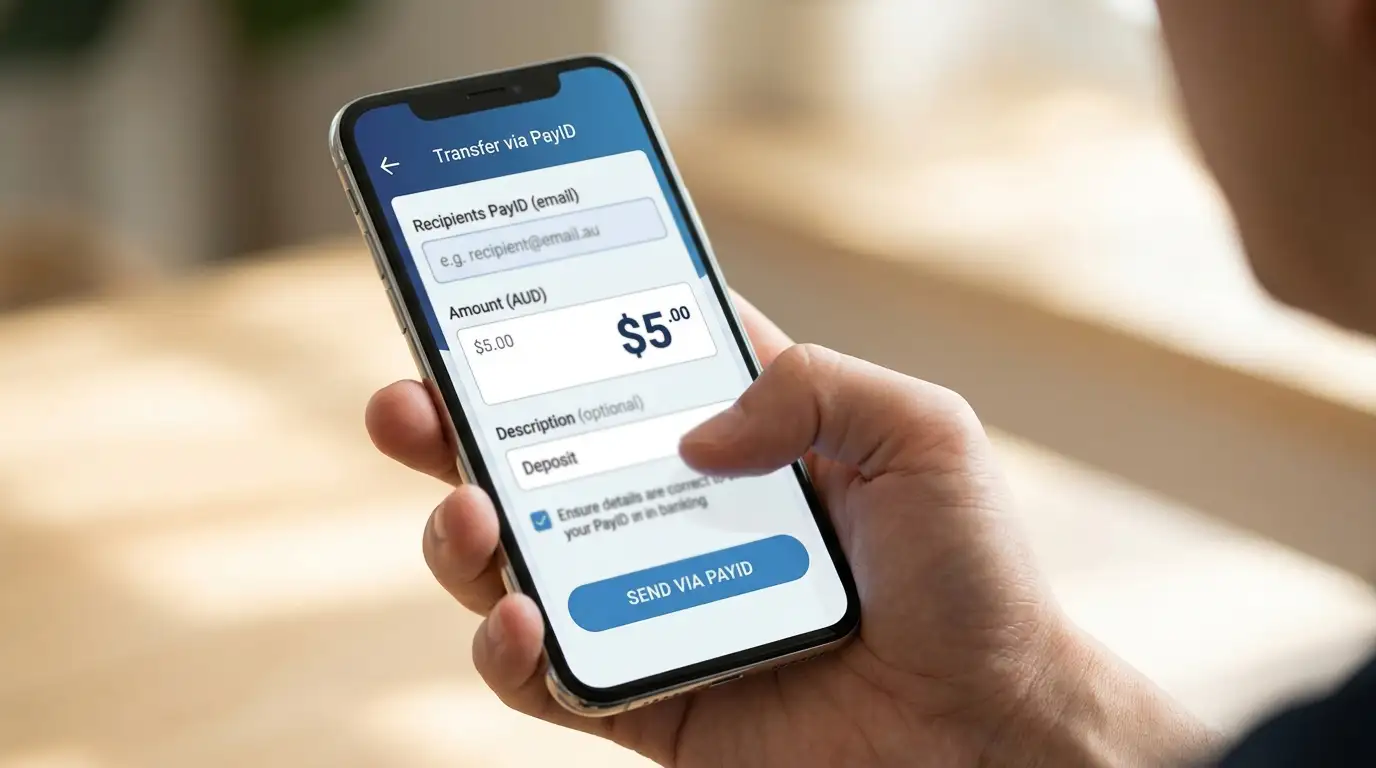
Your payment method sets the floor, not the casino. A site can advertise “no minimum deposit” all it likes, but if Visa won’t process a $5 gambling transaction, the deposit fails. Here’s what actually works in Australia for deposits under A$10.
PayID / Osko — Instant AUD, A$10–A$20 Floor
PayID is the addressing layer (send money via email, phone or ABN instead of BSB + account number); Osko is the settlement layer (real-time payment on Australia’s New Payments Platform). Every PayID transaction uses Osko for settlement—they’re two names for the same rail.
PayID has no technical minimum. The NPP processes any amount from $0.01 upward, 24/7. But casinos enforce their own minimums anyway, typically A$10–A$20, because smaller deposits trigger fraud checks and cost more to process than they’re worth. Neon54 is the standout at A$10 genuine across all methods including PayID. Most others sit at A$20.
Bank daily limits for PayID/Osko: Commonwealth Bank and Westpac default to A$20,000 (adjustable to A$50,000 with two-factor authentication), NAB and ANZ default to A$25,000, ING defaults to A$1,000 (slider up to A$20,000 in-app). If your deposit gets declined despite the casino accepting it, check your bank’s outbound payment limit.
PayID deposits are instant. The casino’s payment processor receives the Osko settlement 4–8 seconds after you send it from your banking app. Some casinos require you to include a reference number in the payment description so their cashier can auto-match the deposit to your account—missing the reference means the settlement lands but doesn’t credit, and you’ll need to contact live chat to manually match it.
PayID withdrawals work the same way—instant settlement once the casino releases the payment. Expect 24–48 hours for the operator’s internal approval, then seconds for the NPP transfer to land in your account. First withdrawals always require KYC clearance regardless of rail.
Crypto — Which Coins Work at $1 and Which Burn It in Fees
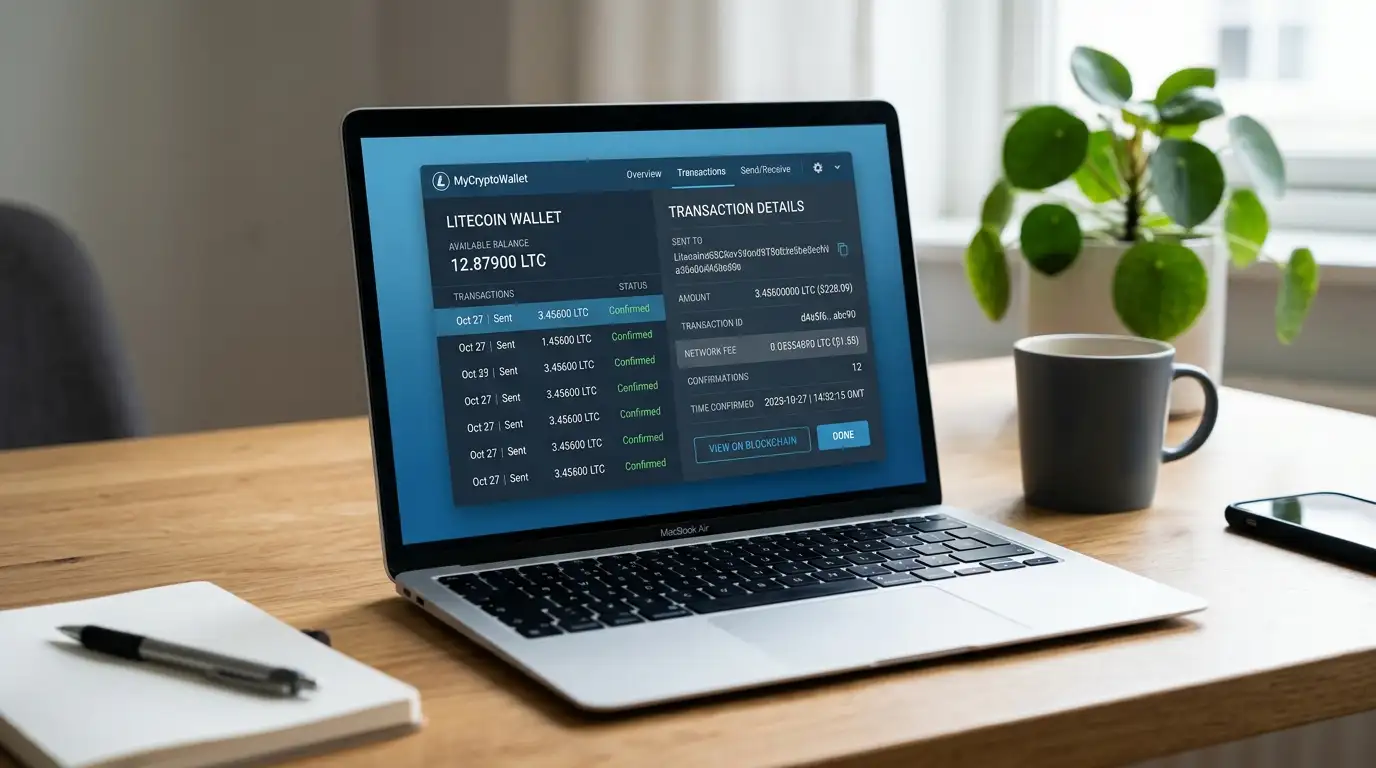
Cryptocurrency deposits bypass card-network floors entirely, which is why every casino in the sub-$5 tier is crypto-focused. But network fees eat micro-deposits if you pick the wrong coin. The table below shows typical transfer costs and confirmation times as of 2026.
| Coin | Network Fee | Confirmation Time | Verdict for $1–$5 Deposits |
|---|---|---|---|
| Litecoin (LTC) | $0.01–$0.05 | ~2.5 min | Best all-rounder—fast, cheap, works everywhere |
| Tron (TRX, native) | $0.01–$0.10 | ~1 min | Excellent—slightly higher fee than LTC but faster |
| Dogecoin (DOGE) | ~$0.01–$0.03 | ~1 min | Excellent—cheap and widely supported |
| Bitcoin (on-chain) | $1–$5 | 10–60 min | Unusable—fee exceeds deposit at $1–$5 |
| Ethereum (mainnet) | $1–$10 | 1–5 min | Unusable—gas makes micro-deposits pointless |
| USDT (TRC-20) | $1–$3 | ~1 min | OK for A$20+, wasteful at $1–$5 |
Keep total fees under 5% of the deposit. For a $1–$5 bankroll, that means Litecoin, native Tron or Dogecoin—all three settle in minutes for pennies. Bitcoin and Ethereum mainnet are unusable for micro-deposits; you’ll pay more in fees than you deposited.
One more cost to watch: exchange withdrawal fees. If you buy $1 of Litecoin on an exchange that charges $1 to withdraw crypto to your own wallet, you’ve just doubled your cost. Buy a slightly larger amount once (say, $50), withdraw it to your own wallet, and feed micro-deposits from there. That way the exchange fee is amortised across multiple casino deposits rather than eating one.
Network fees are paid separately from the deposit amount—the casino receives exactly what you send. A $1 LTC deposit with a $0.02 fee means you pay $1.02 total and the casino credits $1.
Neosurf — A$10 Voucher Floor
Neosurf is a prepaid voucher system. You buy a voucher at Coles, 7-Eleven, Australia Post or a newsagent, receive a 10-digit code, and enter it at the casino cashier. The minimum Neosurf voucher denomination is A$10, so even though some casinos advertise a lower deposit floor, Neosurf enforces A$10 as the practical minimum.
Neosurf deposits are instant—the voucher code is validated and the balance credits immediately. No bank trace, no card statement, no PayID record. The downside is that Neosurf is deposit-only; you can’t withdraw to a Neosurf voucher. You’ll need to nominate an alternative withdrawal method (PayID, crypto, e-wallet) when you cash out.
Vouchers are sold in fixed denominations: A$10, A$20, A$50, A$100. If you deposit a A$50 voucher and your casino balance is A$30, you can’t get the remaining A$20 back onto the voucher—it’s gone. Use voucher amounts that match your intended deposit to avoid wasting the difference.
Neosurf works well for players who want to avoid a bank trace but don’t want to hold crypto. The A$10 floor is fixed by the voucher system, not the casino, so advertising a “A$5 minimum” at a casino that accepts Neosurf is meaningless—you can’t buy a A$5 voucher.
Cards and E-Wallets — Why They’re the Worst for Micro-Deposits
Visa and Mastercard have merchant minimums that vary by processor, typically A$10–A$20 for gambling transactions. Australian banks increasingly flag repeated small gambling transactions as suspicious and may block them. Cards also carry a risk of cash-advance fees if your bank classifies a casino deposit as a cash-equivalent transaction rather than a purchase.
E-wallets (Skrill, Neteller) impose their own minimums, usually A$5–A$20, and charge account fees on top. They’re often excluded from bonus eligibility, so a small deposit via e-wallet may not activate the welcome offer even if the amount meets the threshold. E-wallets add a middleman layer without lowering the floor, making them pointless for micro-deposits.
If you want a sub-A$10 deposit, use crypto. If you want A$10 fiat, use PayID. Cards and e-wallets are the worst of both worlds for small amounts.
Which payment method lets me deposit the smallest amount?
Cryptocurrency—specifically Litecoin, Tron or Dogecoin. Those three coins have network fees under $0.10, and casinos like Stake, Cloudbet and Jackbit accept deposits as low as $1 or even dust amounts. PayID is the best fiat option, but casino minimums are typically A$10–A$20. Neosurf vouchers start at A$10. Cards often have merchant minimums of A$10–A$20 and higher fraud-check thresholds. For a true micro-deposit under $5, crypto is the only real answer.
The Withdrawal Trap — Minimum Cashout Floors
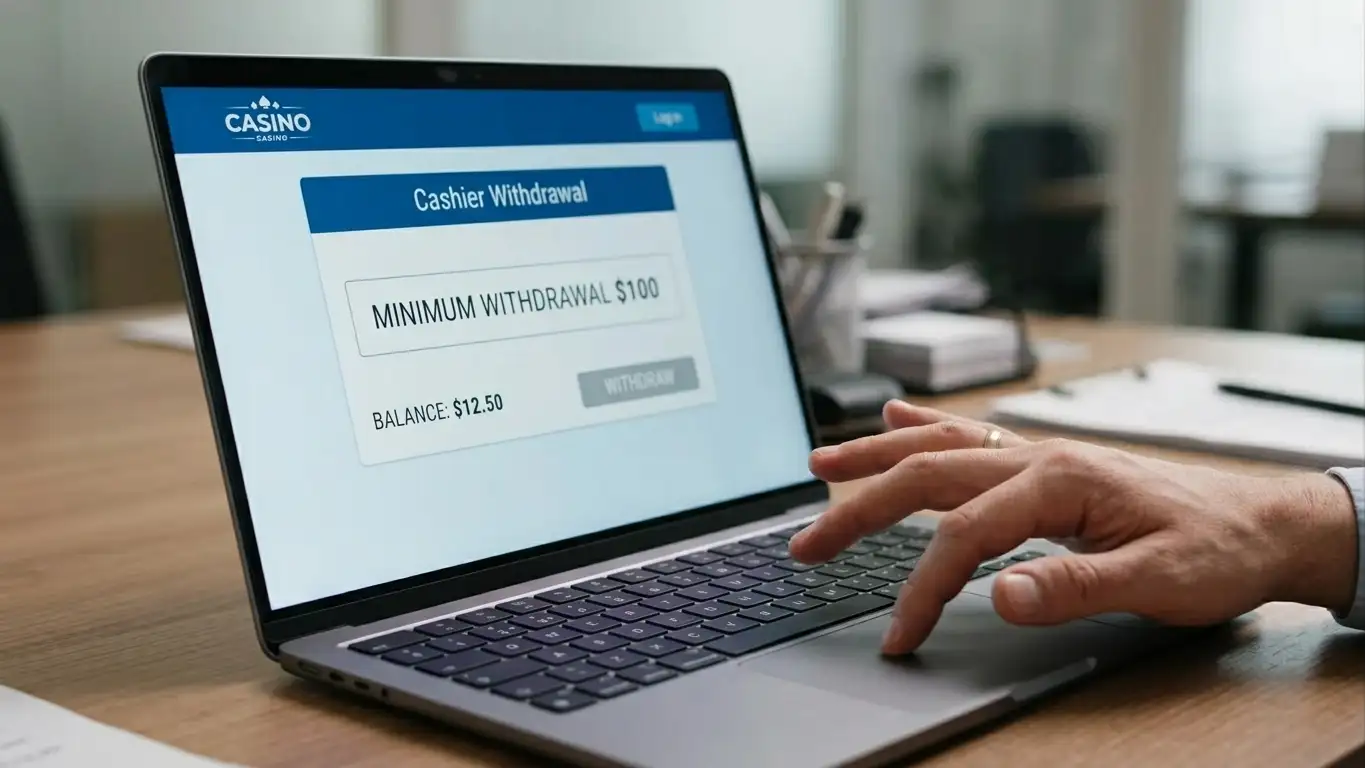
A casino that accepts a $1 deposit but enforces a $100 minimum withdrawal has effectively locked your micro-deposit in until you multiply it a hundred times. That’s not a theoretical risk; it’s the standard operating model. The deposit floor and the withdrawal floor are set independently, and the gap between them is where most micro-deposits die.
Typical withdrawal minimums at Australian-facing offshore casinos: A$20–A$100, depending on operator and method. Crypto withdrawals tend to have lower floors (A$10–A$20) because blockchain settlements cost the casino less. Fiat withdrawals (PayID, bank transfer) typically start at A$50–A$100 because of payment-processor fees. E-wallet minimums sit in between.
Here’s the trap in practice. You deposit $1, play a few spins, hit a small win and your balance reaches $50. The withdrawal minimum is $100. You can’t cash out yet, so you keep playing. The house edge works on every spin, and your $50 drifts back down to $30, then $10, then zero. You just learned an expensive lesson: the withdrawal floor is the real minimum, not the deposit floor.
Some operators waive or lower the withdrawal minimum for crypto. Stake processes withdrawals from around $1 upward. Cloudbet sits around $10–$20. Most fiat-focused operators (Fair Go, King Billy, Red Stag) enforce A$50–A$100 minimums and won’t budge. Before you deposit a micro-amount, check the withdrawal page—not just the deposit page—and calculate how many times you’d need to multiply your balance to reach cashout. If the multiple is over 10x, you’re not testing a casino; you’re donating.
The smartest use of a micro-deposit is not to win money but to test the full cycle: deposit $1, play one spin, request a withdrawal (even if it’s under the minimum and gets rejected). If the casino processes the rejection cleanly and returns your balance, you know the cashier works. If it stalls, disappears or demands excessive KYC for a $1 test, you’ve identified a problem operator for the cost of a dollar.
Can I withdraw winnings from a $1 deposit, or is there a minimum cashout?
Most offshore casinos enforce a minimum withdrawal of A$20–A$100, regardless of how much you deposited. Crypto-focused operators (Stake, Cloudbet, Jackbit) tend to have lower cashout floors (A$10–A$20 or even $1 at Stake), while fiat-focused operators (Fair Go, Red Stag, King Billy) typically require A$50–A$100. That means a $1 deposit that wins $50 might not reach the withdrawal threshold, forcing you to keep playing and increasing house-edge exposure. Always check the withdrawal minimum before depositing a micro-amount—if the cashout floor is 50x or 100x your deposit, you’re not testing the casino, you’re gambling on a long-shot multiplier.
Bonuses at Micro-Deposits — When “Free” Costs More Than You Deposited
A typical offshore casino welcome bonus is a 100% match up to some figure, often with 35x–50x wagering requirements on the bonus amount. Sounds generous until you run the numbers on a micro-deposit. Deposit $1, get a $1 bonus, and you now have $2 in your account. The 40x wagering requirement (common at Curaçao casinos) applies to the $1 bonus, so you must place $40 in bets before you can withdraw anything.
The house edge on a typical pokie is 3%–5%. At 4%, $40 in turnover costs you an expected $1.60 in losses. You’ve just paid $1.60 to claim a $1 bonus. That’s not a gift; that’s a fee with a bow on it. The casino knows the math—that’s why they’re happy to take your dollar and call it a “bonus.”
Wagering requirements scale badly at micro-stakes. A $20 deposit with a $20 bonus and 40x wagering requires $800 in turnover, which at 4% house edge costs an expected $32—still a loss, but at least the bonus covers part of it. A $1 deposit with the same structure loses more than the bonus is worth. The smaller your deposit, the worse the deal.
One more trap: the bonus-qualifying minimum is often higher than the stated deposit minimum. A casino might accept a $1 deposit but require $20 or $30 to activate the welcome bonus. You can deposit the dollar, but the “100% match up to $1,000” won’t trigger. That’s not disclosed on the homepage; it’s buried in the bonus terms under “minimum qualifying deposit.” Always check that figure before opting into a bonus.
Rakeback systems work better at micro-stakes. Gamdom’s 15% instant rakeback for the first seven days returns $0.15 in cash for every $1 wagered, with no playthrough and no hoops. That’s far more useful than a match bonus you’ll never clear. If you’re depositing under $10, skip the match bonus and look for rakeback, cashback or wager-free rewards instead.
Will a $1 deposit qualify for the welcome bonus?
Probably not. Most offshore casinos require a “minimum qualifying deposit” of A$10–A$30 to activate the welcome bonus, even if the technical deposit floor is lower. A $1 deposit will credit to your account, but the 100% match and free spins won’t trigger. Check the bonus terms for “minimum qualifying deposit” before opting in. Even if a $1 deposit does qualify, the wagering requirement (typically 35x–50x) makes it uneconomical—you’ll lose more in expected house-edge costs than the bonus is worth. Rakeback (like Gamdom’s 15% instant return) is a better structure for micro-stakes than match bonuses.
Pokies, Games and Lobby Access With a Tiny Balance
A $1 deposit does not restrict the game library—you get access to the same thousands of pokies as someone who deposited $1,000. What it restricts is how long your balance lasts. Most online pokies allow minimum spins of $0.10–$0.20, so $1 gives you five to ten spins. That’s enough to test a game’s mechanics and see whether you like the theme, volatility and feature frequency. It’s not enough to chase a free-spins feature or a multiplier win, and it’s definitely not enough to assess a game’s long-term RTP—you’d need thousands of spins for that, and your dollar will be long gone.
High-volatility pokies like Dead or Alive 2, Bonanza and The Dog House eat a $1 balance in two minutes during a dry spell. They can also deliver a 50x or 100x win in two spins, but the swings are massive. Low-volatility pokies with frequent small wins (Starburst, Blood Suckers, Jack Hammer) stretch a $1 balance longer, but the maximum wins are capped lower. If you’re testing a casino’s withdrawal process with a micro-deposit, pick low-volatility games so your balance survives long enough to request a cashout.
Table games have higher minimums than pokies. Blackjack and roulette often require $1 or more per hand, so a $1 deposit is literally one hand. Live dealer games are even worse—most live blackjack tables start at $1–$5 per hand, and live roulette is similar. A $1 deposit in a live dealer lobby is a 60-second experience, not a session. If you want live play, deposit at least $20.
The smartest use of a micro-deposit is not to play for hours or to test a game’s RTP. It’s to verify that the casino’s cashier, KYC process and withdrawal flow actually work as advertised. Deposit $1, play one or two spins, request a withdrawal. If the casino processes the request cleanly (even if it rejects it for being under the minimum), you’ve confirmed the platform is functional. If it stalls, disappears your balance, or invents a reason to block the account, you’ve identified a problem operator for the cost of a coffee.
Do no minimum deposit casinos offer the same games as regular casinos?
Yes. The game library does not change based on your deposit size. A casino with 5,000 pokies offers all 5,000 to a $1 depositor and a $1,000 depositor alike. What changes is how many spins you get—most pokies allow $0.10–$0.20 minimum bets, so a $1 balance gives you 5–10 spins. High-volatility games can drain that in two minutes; low-volatility games stretch it longer. Live dealer minimums ($1–$5 per hand) make a $1 deposit impractical for table play. The game selection is identical; the session length is not.
Mobile Play — Same Floors, Faster Flow
Deposit minimums are identical on mobile and desktop—there’s no separate “mobile minimum” that’s lower or higher. What mobile changes is the flow. Opening your bank app, selecting PayID, pasting the casino’s payment address and confirming takes 30 seconds on a phone. On desktop, that same process involves logging into internet banking or opening a separate authenticator app, and it’s slower and more friction-heavy. For PayID deposits, mobile is objectively faster.
Crypto deposits are also faster on mobile if you use a wallet app—scan the deposit QR code with your camera, confirm the amount, send. On desktop, you’re copying and pasting a deposit address and hoping you didn’t drop a character. The error rate is higher.
No real-money casino apps exist in the Australian App Store or Google Play. Apple and Google both prohibit real-money gambling apps for Australian users in their official stores, so every “app” you see is either a progressive web app (a bookmark that looks like an app) or a web wrapper. The casinos listed in this guide all work in a mobile browser without downloading anything. Some offer progressive web apps—you can add a shortcut to your home screen and launch it like a native app, but under the hood it’s still a browser session.
Mobile UI quality varies. Neon54’s interface works well on smaller screens with fast load times and a clean layout. BitStarz and Stake are similarly polished. Fair Go and Red Stag run on older WGS Technology software, and the mobile experience is clunkier—menus are small, buttons are fiddly, and game thumbnails don’t scale well. If you plan to play primarily on mobile, test the casino’s mobile site in a browser before depositing.
One practical tip: screenshot the banking page terms before depositing. On a small screen, terms and conditions are easy to miss, and if a casino later changes its stated minimum or disputes your deposit amount, a screenshot is your proof. This has saved players from unfair account closures.
How long does a PayID deposit take at a no minimum deposit casino?
PayID deposits are instant—settlement happens in 4–8 seconds via Australia’s New Payments Platform (NPP). Once you send the payment from your banking app, the casino’s payment processor receives it almost immediately, and your balance credits within seconds. Some casinos require a reference number in the payment description so their cashier can auto-match the deposit to your account. If you forget the reference, the settlement lands but doesn’t credit right away, and you’ll need to contact live chat to manually match it—usually resolved within an hour.
NSW and Other State-Level Distinctions (Spoiler: None)
NSW has no separate online casino licensing regime. The Interactive Gambling Act 2001 is federal law—it applies in New South Wales, Victoria, Queensland, South Australia, Western Australia, Tasmania, the ACT and the Northern Territory identically. No state has issued an online casino licence, and no state has the power to override the IGA’s prohibition on offshore operators supplying casino games to Australian residents.
The query no minimum deposit casino nsw appears in search because punters assume state-specific gambling rules might create NSW-only options. They don’t. Land-based casinos in NSW (The Star Sydney, for example) are licensed by Liquor & Gaming NSW, but those licences cover physical venues, not online extensions. Sports and race betting operate under a different part of the IGA and are licensed by the Northern Territory Racing Commission or equivalent state bodies, but pokies and casino games remain federally prohibited online regardless of which state you’re in.
The offshore casinos listed in this guide accept players from all Australian states and territories. There’s no NSW-specific floor, no Victoria-specific restriction, no Queensland carve-out. If you’re in NSW and you want a no minimum deposit casino, you’re looking at the same Curaçao-licensed offshore operators as everyone else in Australia.
One clarification: some casinos advertise geo-targeted landing pages (e.g., “NSW players welcome” or “Melbourne pokies”). That’s SEO, not a licence. It does not mean the operator holds a NSW permit; it means they’re serving you the same offshore product with localised marketing copy.
Why do some casinos advertise “no minimum” but then require $10 or $20?
Because the advertised minimum often applies to one payment method (usually crypto) while the cashier enforces a higher floor for everything else. A casino might genuinely accept $1 in Bitcoin but require $20 for PayID or Visa. The homepage banner says “no minimum deposit,” which is technically true for one rail, but misleading for players who assume it applies to all methods. Always check the banking page for the per-method floor before signing up. The other reason: bonus-qualifying minimums differ from deposit minimums. You can deposit $1, but the welcome bonus might not activate until you deposit $20 or $30. That threshold is buried in the bonus terms, not shown on the cashier.
Min. Deposit Casinos Australia 2026 — $1, $5, $10 & No Deposit
Content created by the «CasinoPay» team